

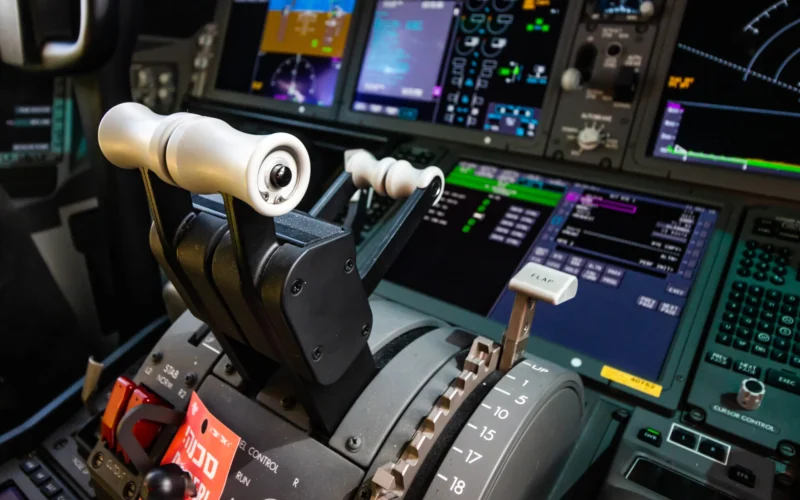
A cockpit voice recording from the Air India Boeing 787-8 that crashed last month in Ahmedabad, India, appears to indicate that the captain may have cut off the aircraft’s fuel supply moments after takeoff, The Wall Street Journal reported on July 16, 2025, citing sources familiar with the preliminary US review.
The accident, which took place on June 12, 2025, killed 260 people, including 241 of the 242 on board and 19 on the ground. The aircraft, operating as Flight AI171 from Ahmedabad (AMD) to London-Gatwick (LGW), crashed into a residential area less than a mile from the runway after both engines lost power.
Exchange in the cockpit
According to the WSJ, the first officer, who was the pilot flying, asked the captain why he had moved the fuel control switches to the “cutoff” position shortly after takeoff. The captain reportedly replied that he had not done so.
The cockpit exchange aligns with preliminary findings released by India’s Aircraft Accident Investigation Bureau (AAIB) on July 12, 2025, which confirmed that both engine fuel switches transitioned from “RUN” to “CUTOFF” within a second of each other during the initial climb. However, the AAIB report did not attribute the action to any crew member.
The captain, 56, had over 15,600 flight hours (8,500 on the 787), while the first officer, 32, had 3,400 hours in total.
Sources told WSJ that the first officer would likely have been too focused on flying the aircraft to manually cut fuel at that critical phase of flight.
Attempts to recover power
Flight data indicates the switches were returned to “RUN” within 10 seconds, triggering the 787’s automatic restart logic. One engine briefly showed signs of recovery, but the aircraft had already slowed and descended to an unrecoverable state. The Ram Air Turbine deployed as hydraulic and electrical power failed.
Security camera footage captured the RAT deployment almost immediately after liftoff, signaling rapid engine power loss. The aircraft reached a maximum altitude of around 650 feet before descending and striking multiple buildings near BJ Medical College.
Ongoing investigation
Air India CEO Campbell Wilson said in an internal memo that the preliminary report had identified no mechanical or maintenance-related failures. The AAIB has issued no safety recommendations, and US and European regulators have reiterated confidence in Boeing’s fuel switch locking mechanisms. A final report is expected within 12 months.
The crash has reignited debate over installing cockpit video recorders in commercial aircraft. Investigators have said such footage could have clarified the crew’s actions during Flight AI171’s final seconds.
43 comments
Well if this is the cause then Boeing must put safety lock such that the fuel lever cannot operate until it reaches a certain height after take off.
the crew needs to be able to cut off fuel at any time in case of an engine fire
But that would prevent when another cause low level crash eminent event occurred, when turning the fuel off would be needed.
I can think of several situations where doing as you suggest would doom the plane and crew.
That’s not wise either; in the event of engine fire, or physical loss, the 1st thing you need to do is cut off the fuel, and a lock out could be just as deadly as that crash.
This is simply bizarre. Attributing the whole sequence of unknown events to a person who is no longer present in this world to defend his professional integrity and bona-fides, smacks of corporate greed and ugliness of Big Business. WSJ is a respected journal and jumping to conclusions just on couple of seconds of cockpit conversation, doesn’t speak highly of journalistic ethics. Wait for the final exhaustive accident report and then only attribute motives- real or grossly imaginative.
It was the AAIB that stated this information from the recorders. WSJ is just repeating the provided information as are many other news organizations. Do not vent anger at the WSJ- vent at the AAIB that was doing their job.
Buzzard: I fully agree with you. Moreover, the captain replied to the F.O that he didn’t move the fuel levers. A few seconds later, the two levers were positioned back to ON by one of the 2 pilots (probably the non flying one) without the interference of the other crew member. Then, a “mayday” message was issued which should tell that the movement wasn’t deliberate ! It’s a pity that all those comments are made without any proof being brought by the preliminary report. Let’s wait until further study may provide explanations, certainties and conclusions.
I agree Buzzard. Basil Kilian
Sadly, it is so often the pilot is blamed; after all he is no longer there to defend himself. Anything, to save corporate face.
Initiation of RAT deployment is most likely too soon for initiation by the “transitions” of the fuel switches. Was something else going on?
Photo evidence has the RAT deploying more or less at liftoff, give or take at most 1 or 2 seconds. Switch “transition” 3 seconds after liftoff, followed by 2-4 seconds engine unspooling are are necessary for the RAT deployment by fuel cutoff assumed by the WSJ.
Airlines have to change culture so pilots are not afraid to come forward with mental distress concerns. This makes much more sense than hiding it. Pilots are human beings. They deserve a team that will work with them. No one is Superman(woman). How many tragedies have to happen before this issue is confronted and resolved. God bless all involved and ♥ 787, goodbye girl.
So as per the Wall Street Journal a highly respected Training Captain lied to his pilot flying copilot that he did not switch off the switches. Can Wall Street journal stop so low Just so that their compatriot manufacturer’s interest has to be protected.
I reproduce the opinion of the AI Agent Perplexity final statement here.
“The FAA’s decision not to mandate the 787 fuel switch locking fix fits an established pattern of Boeing and the regulator opting for measures that avoid significant financial and operational consequences for the manufacturer—even amidst broader concerns about compromised safety culture, as was evident in the 737 MAX saga.”
I have nothing more to say. Shame on the people responsible.
Well, somebody reached down and turned those fuel switches off, they didn’t do it by themselves and one pilot asked the other pilot. Why did you do that?
So your comment makes no sense whatsoever someone in that cockpit turned all switches off deliberately which makes it murder/suicide!
Here, here!
“Flight data indicates the switches were returned to “RUN” within 10 seconds, triggering the 787’s automatic restart logic. One engine briefly showed signs of recovery, but the aircraft had already slowed and descended to an unrecoverable state. The Ram Air Turbine deployed as hydraulic and electrical power failed.”
The people who authored this are believing that the Boeing autostart logic can overcome the pull against the spring tension and raise it 2.8mm and put it to the run position from cutoff position. The same reasoning about them having the locking mechanism failure as flagged by Boeing in 2018 is hypocritically not pursued.
I don’t think this is what it is saying. I think the auto-restart logic happened after the switches were manually moved back into the run position. It is not saying the auto-restart caused the switches to move from stop to run.
Are cameras installed in surgery rooms? OK, you eventually kill one individual at a time if you make a mistake and not hundreds, but on the long run…
Installing them in the cockpit would be a serious privacy violation and could be used for other reasons than post accident investigations
no. this would increase flight safety.
privacy needs vs flight safety; flight safety must win
Why? There are cameeas in my office, in the supermarket, on the tube stations, on the public buses, why not in the cockpit of a ppane carrying hundreda of people? While flying the plane, pilots are at work. Besides, sound is alreasy recorded. Viseo would hive us the full picture. Moat likely a case like this would be alreasy solved.
Since the fuel switch has multiple safety features, it is understood that there is no chance of it being turned off accidentally. So was it done deliberately? The captain also asks why you turned it off on the voice recorder.
Secondo me una volta che il wow è disattivato per spengere i motori basterebbe mettere un pulsante per lato che deve dare il secondo consenso magari con una logica Pilot in command integrata cioè che riconosce il pilota che ha le mani impegnate per la condotta del volo, un po come nei fil della doppia chiave per il lancio dei missili.
I keep wondering…is there any possible way the fuel supply could have been cut electronically without human input?
There’s more to be known, before jumping to conclusions.
It has been said that the fuel control switches were recovered from the wreckage. Is there *any* evidence that the locking mechanism wasn’t rock solid? There are people asserting that the two switches could (magically?) move without a pilot doing it… but the locking mechanism is supposed to prevent exactly that kind of unintentional movement.
With the Captain’s reputation at stake now, it’s even more important to know, is there any way that the flight data recorder could show the fuel control switches changing state, without them actually being moved? Some kind of electrical/data glitch?
Which switch was turned off first, right or left? Intuitively the pilot would turn off the switch closest to him first and then the next furthest a second later. This could suggest which pilot cut the fuel
FADEC shuts down both engines due to senser problem and pilots working hard to restart. Look at the FDR switch movement time line contrast to pilot switch positioning time line during restart attempt. Also, Refer to ANA 787 FADEC engine shutdown during taxi (2013). This is a FADEC issue. (FADEC=Full Authority Digital Engine Control)
I designed nuclear plant controls. All critical controls require a confirmatory action – an arming collar, or (as in this case) a dual-action switch (pull then toggle). There is no requirement to design against malevolent actions.
It is incomprehensible to me how a pilot could cut off the fuel supply at any stage of flight. There is something very mysterious about the initial reports. They say it will take about a year before the facts are known. Boeing has been plagued with problems starting with the B737 Max and with the lithium
Batteries on the B787. It is hoped there are no more incidents before the facts are known which are supposedly 12 months away.
It is important to keep in mind that there are several instances when a crew member deliberately crashed a plane with passengers on board. To say it is incomprehensible is to say crews can’t face life situations and take an action due to mental illness. It is important to keep an open mind that it is a possibility while the investigation proceeds and in the meantime, and not jump to conspiracy theories. There are several instances where investigators discovered a deliberate action was the cause of a crash.
Egypt Air 990. Boeing 767 LAX/JFK to Cairo. 10/31/99 NTSB intentional grounding finding. ECAA refused to cooperate and listed mechanical failure of some sort, which has been heavily disputed by all authorities but Egyptian.
Gremanwings flight 9525. Airbus A320 Barcelona to Dusseldorf 3/24/2015. Co pilot locked captain out of cockpit and deliberately crashed the flight into the French Alps.
Mozambique Airlines flight 470 11/29/13. Very similar crash to Germanwings 9525. Copilot locked out of cockpit by Captain, and evidence Captain deliberately took action to sabotage the flight.
Japan Airlines 350 2/9/82.
Royal Air Maroc flight 360 8/21/94
Silk Air flight 185 12/19/97
Air Botswana 10/11/99
Malaysia flight 370 Boeing 777. 3/8/14. which has suspicion of foul play with mysterious shutdowns of flight systems. No cause determined as wreckage has never been found, but there is transponder evidence that might indicate a crew action as one of several possible causes. We will probably never know.
Let’s wait and see what is discovered when the full report on the Air India crash is published. It isn’t incomprehensible, but it is one possible cause.
See this article on the safety of fuel control switches : https://us13.campaign-archive.com/?e=e56a7cf2ce&u=2ad9e3d3df9bb89de369b3344&id=b521db312d
Well going through the feedback closely it is clear there was a technical problem. The aircraft has taken too long a run before takeoff from the ground. This could be either due to unreported over weight, or Engine not generating required power or any other technical fault. Under the circumstances pilot could not even abort the take off as the flaps were in the correct position. Now what was the technical problem should have come out by now else the so called black boxes feed back is just a eye wash. OR the investigation team is trying to protect Boeing by not releasing the real reasons for the accident. But innocent citizens have paid for their lives. Yes people will try to avoid flying in Boeing aircraft for years to come which will be a long term loss to operators.
How about reading before you blurt out, the answers are in the comments, reading your responses tells me you can read and write, does not prove your comprehension. Stop posting nonsense. “unreported” “eye wash”. Take time to understand roles and responsibilities of “AAIB’, ‘NTSB’ and organization like them. Boeing and its engineers have been at this for more than your lifetime. Living in an alternate reality or just regurgitating what you heard. Let the professional’s do their job and wait for their finding.
Ahora resulta que el organismo indio de aviación civil encargado de la investigación, es de la Boeing según varios comentarios de este artículo. Su actitud anti-Boeing es ilimitada.
One thing that has not been made clear (to me at least) and it may be a minor point for most others
Were the pilots speaking English? I ask this because the transcript of the CVR was in English, I want to know if those were the “actual words” spoken by the pilots or a “translation” of the words spoken by the pilots. Those listening to and transcribing the CVR must know which pilot spoke which words but chose not to include that in the report. The words were “Why did HE do that?” Emphasis mine. I’ve worked with many non-native English speaking professionals. It is a common (minor slip up) to confuse “First, second and third person singular and plural” pronouns especially when speaking rapidly such as under stress, which was this situation.
I have no experience with aviation. My understanding is that the pilot flying, PF, (the FO in this instance) pushes the throttles to T.O. power then returns his hands to the yoke. The pilot monitoring, PM, (the captain in the instance) covers the throttles ready to pull them back to idle should the PF call for an aborted Take Off. Once the aircraft rotates the PM removes his hands from the throttles because the plane is committed to flying.
My speculation: is the captain moved the fuel cutoff switches, his hands were closest to them. The FO had his hands on the yoke and was trying to fly the plane. If the PF wanted to crash the plane he could have just pushed forward on the yoke but that could have been countered by the PM pulling back on the yoke, probably would have stilled crashed but the FDR would have shown conflicting control inputs.. Moving the switches to Cut Off was a much more subtle way of initiating a crash.
Also, my understanding.when a crash like this occurs, ALL possible causes are investigates in parallel , e.g fuel contamination, sabotage, mechanical/electrical failure, pilot error or intention, etc. And that includes looking into the back ground of both pilots at the very beginning of the investigation. Only after thorough research are the causes excluded one by one. Why have we not heard, as of now, the back ground of the pilots? Seems like the Indian media and public opinion were avoiding that from the very start.
Since the plane could not have taken off unless the switches were set to run, and since the locking tabs prevent the switches from rocking to an off position (the switch needs to be pulled up and then over to turn it off), and since the voice recorder indicated a conflict of information between the pilot and copilot, something indeed seems sketchy. While it looks like murder to me, we will have to wait until the investigation is complete. Federal/international air authorities are more reliable than politicians or speculation from the masses.
Over the years there have been a number of ref pilot suicide induced crashes. I was a 747 Captain for 15 years and about a second is the time it takes to throw two fuel control switches. It would be easy enough for either pilot to do this, even the flying pilot as they are right at hand dropping down from the thrust levers. I have examined DFDR type data before and it is a matter of integrating in a timeline many simultaneous occurrences. If the flying pilot did this there would likely be some small unintentional control movement. This was only unrecoverable because of the low altitude and airspeed. It is a significant argument for keeping at least two pilots in the cockpit at all times.
Boeing should install a video recorder that automatically deletes the footage after each flight.
THE CREW IS SUBJECT TO THEIR VOICES BEING RECORDED (CVR), SO WHAT IS THE BIG DEAL HAVING A CAMERA ?
(DO THEY MISBEHAVE IN SILENCE ?) THE NTSB HAS A HECK OF A TIME DISCOVERING SITUATIONS THAT MIGHT NOT BE 100% ABSOLUTE. THE CAMERAS WILL REVEAL LOTS MORE, QUICKLY AND RESOURCEFULLY.
As a retired Captain with a Franch Airline, I used to fly Airbus and Boeing aircrafts (older like A300/310 and Boeing 737-200, more recent like A330/340/380 and B747-800).
In the older types, there is no way: fuel control switches on the central panel were the only mean to mechanicaly cutoff fuel and stop the engine.
In the more recent types and their engines, the Fuel Control Unit (FCU) became quite computerized from the older électro-mechanicaly driven version.
I’m just wondering if, by any bad luck, some computing glitch could be at the source of this accident..
From what I can read on this subject here and there, it could be a voluntary action (Cutoff) from one of the crew members and 10 sec. later, the same crew member would have put them back in position (Run): where is the logic ??
Can any qualified CM on 787 comment on this post ?
Thanks
as of this moment in time, it”s sucks of a complete cover up, and blaming a soul who no longer with us,
too many if and but situation,!!
Pilots have an SOP specifying what they can and what they can’t touch after takeoff. A guy age 56, having 16000 hours under his belt, deserves some respect for transporting millions of passengers safely during his career. No pilot kills himself with other 300 innocent people onboard. Boeing and Air India need to resort to old school books now. Enough is enough blaming pilots to exonerate the manufacturer and the airline management.
Being type rated on the B747, B757, B767 & B777 with 13,000 hours it’s my opinion that aircraft manufacturers have gone too far with automation. In my experience the peak of progress was the B757/767 era. This is when manufacturers put enough technology in aircraft to make the pilots job both easier and more efficient but took ZERO control away from them. The flight controls on the B757/767 and B747 are traditional cables and pulleys that are directly connected to the pilots controls and flight control servos. Newer aircraft like the B777/787 use fly-by-wire which creates a disconnect between the pilot and the aircraft. For example, on the 777 when the pilot makes a control input it’s sent to 3 separate computers that convert the physical signal into a digital output. That signal is then sent to 4 other computers that “optimize” the command signal and send it back to the first three computers. That modified signal is then sent to the flight control servos.
On older aircraft like the 737/757/767 when the pilot moves a control it’s sent directly to the flight controls. I can tell you, as a pilot which one I prefer. Manufacturers will say it’s because FBW promotes safety. I disagree. It’s because it’s much cheaper to build a FBW aircraft than a traditionally rigged aircraft.
While participating in an earlier crash investigation, I became aware of an impressive number of irregularities pointing to a surprising level of skulduggery by the airframe manufacturer’s go team, abetted by FBI personnel. This was done by removal of evidence. Details: https://reportajes-ee.s3.us-east-1.amazonaws.com/specials/avianca-203/capitulo5.html