


Boeing generated positive free cash flow in the second quarter of 2026 as rising commercial aircraft deliveries lifted revenue and helped narrow the US manufacturer’s net loss.
Revenue reached $24.56 billion during the three months ending June 30, 2026, an increase of 8% from $22.75 billion in the same period last year, Boeing announced on July 28, 2026.
The company delivered 171 commercial aircraft during the quarter, up 14% year-on-year and its highest quarterly total since 2018. The figure brought first-half deliveries to 314 aircraft, compared with 280 during the opening six months of 2025.
Boeing recorded a net loss of $428 million, an improvement from the $612 million loss reported a year earlier. Its loss per share narrowed from $0.92 to $0.67, while the core loss per share improved from $1.24 to $0.76.
Operating cash flow rose to $1.36 billion from $227 million. Free cash flow, a closely watched measure of Boeing’s recovery, turned positive at $631 million, compared with a $200 million outflow in the second quarter of 2025.
The result marked a sharp improvement from the first quarter, when Boeing burned $1.45 billion in free cash flow, despite reporting a near break-even net result.
“I’m very pleased with the progress our team is making as we execute our plan,” Boeing President and CEO Kelly Ortberg said. “Our operations are more stable and key certification programs remain on plan.”
Ortberg cautioned that “there is more work ahead in the second half of the year,” but said Boeing’s momentum continued to move the company “in the right direction.”
Boeing accelerates 737 production
Boeing Commercial Airplanes generated revenue of $11.75 billion, up 8% year-on-year. Its operating loss narrowed to $322 million from $557 million, while its negative operating margin improved from 5.1% to 2.7%.
The company said the 737 program began transitioning toward a production rate of 47 aircraft per month during the quarter. It also activated low-rate initial production on its fourth 737 assembly line, known as the North Line, in Everett, Washington, in July.
The expansion follows a period of production stabilization and supply-chain disruption. Earlier in 2026, damaged wiring on several undelivered 737 MAX aircraft delayed around 10 handovers from the first quarter into the second.
Boeing delivered 129 aircraft from the 737 family during the quarter, alongside 10 767s, seven 777s and 25 787 Dreamliners.
Certification flight testing has now been completed for both the 737-7 and 737-10, Boeing said. The manufacturer continues to expect both variants to be certified in 2026, with first deliveries scheduled for 2027.
The 777X program also received Federal Aviation Administration approval to begin certification flight testing under Type Inspection Authorization phase 4B. Boeing maintained its target of delivering the first 777X in 2027, following the $4.9 billion charge recorded in 2025 after the latest schedule revision.
Commercial Airplanes booked 246 net orders during the quarter, including deals with Korean Air, Delta Air Lines and SMBC Aviation Capital. The division ended June with more than 6,200 aircraft in its backlog, valued at a record $597 billion.
Air Force One losses weigh on defense business
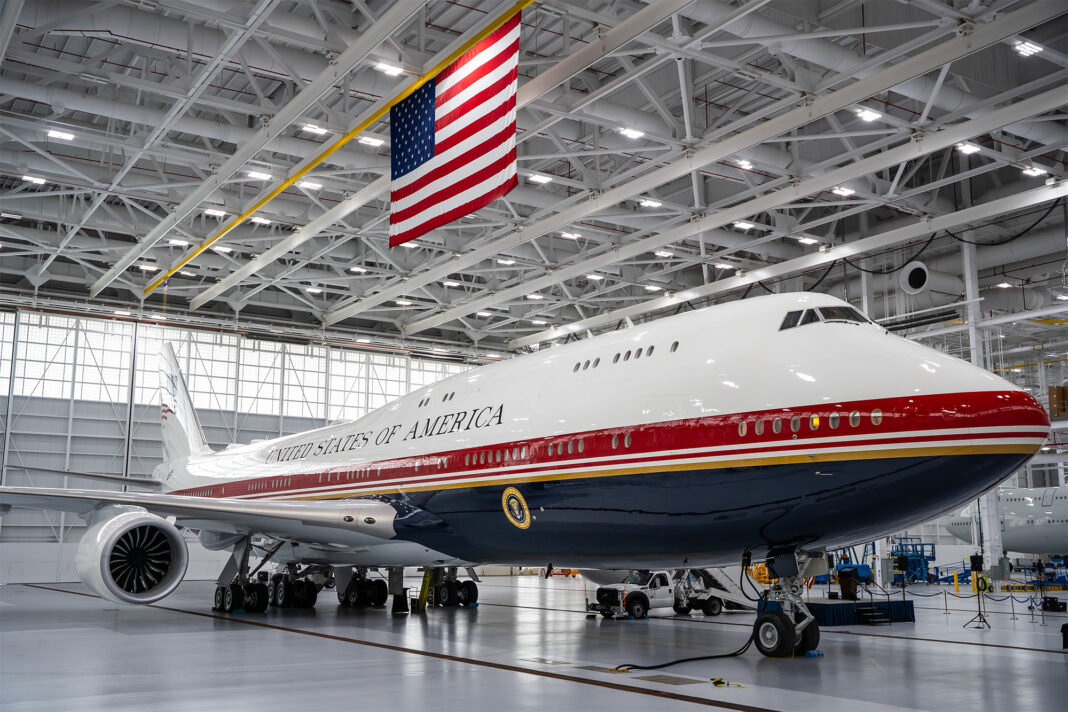
Boeing Defense, Space & Security increased revenue by 13% to $7.48 billion but slipped to a $15 million operating loss, compared with earnings of $110 million a year earlier.
The result included $280 million in additional losses on the VC-25B program to develop two new Air Force One presidential aircraft. Boeing attributed the charge primarily to further investment in production and certification resources.
The company continues to expect the first VC-25B delivery in 2028.
During the quarter, Boeing also completed the first flight of the US Navy’s MQ-25A Stingray and secured approval to move the unmanned tanker into production. It separately began low-rate initial production of the US Air Force’s T-7A Red Hawk trainer.
Defense backlog stood at $85 billion, of which 27% came from customers outside the United States.
Global Services remained Boeing’s most profitable division, recording revenue of $5.34 billion and operating earnings of $968 million. Its operating margin declined from 19.9% to 18.1%, reflecting the divestment of Digital Aviation Solutions, higher costs and an unfavorable sales mix.
Boeing’s total backlog reached a record $715 billion at the end of the quarter, up from $682 billion at the end of 2025. The company held $20 billion in cash and marketable securities, while consolidated debt declined from $47.2 billion at the end of March to $45.9 billion.