
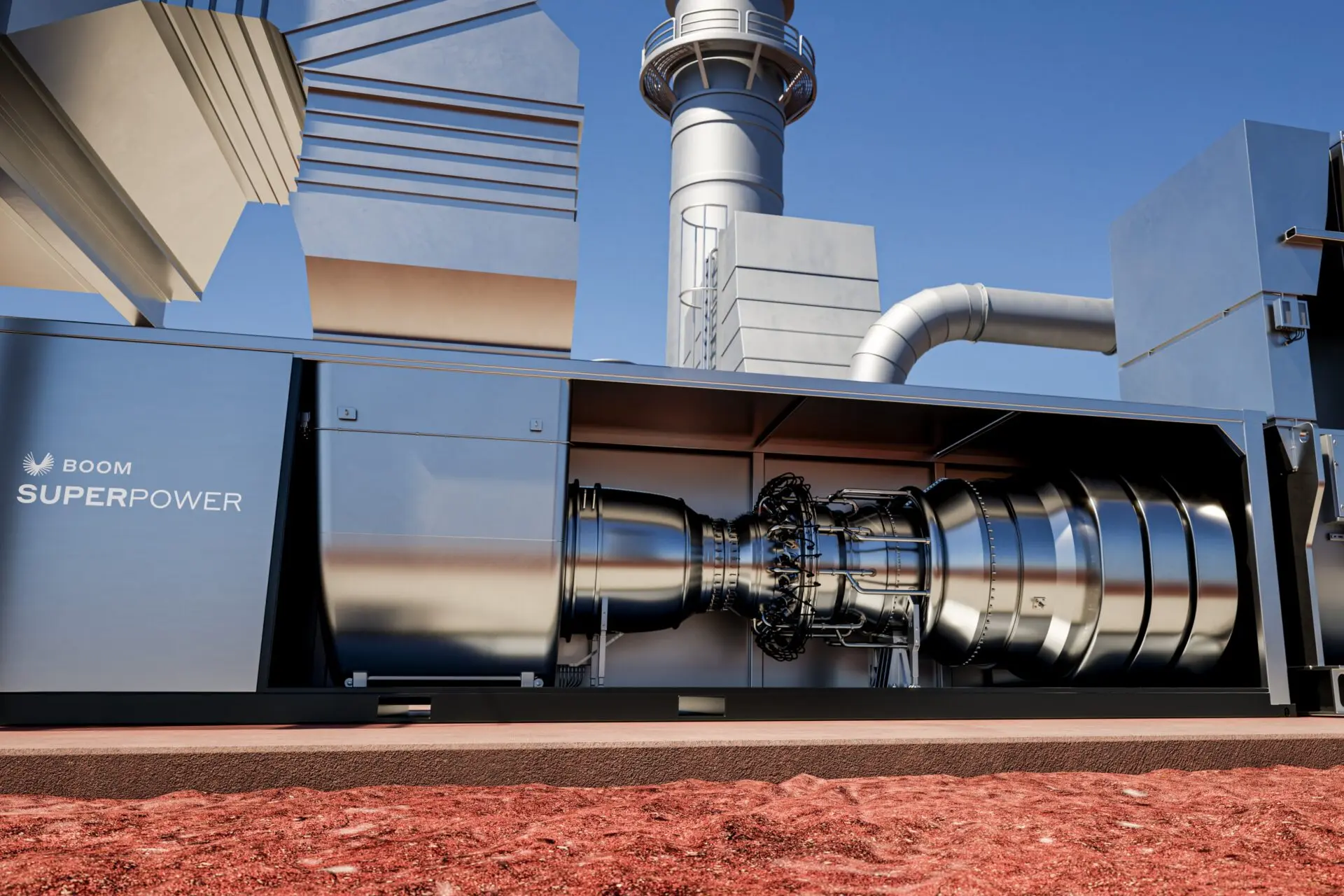
Boom Supersonic has taken an unexpected step into the AI infrastructure sector, securing a $1.25 billion launch order for its new Superpower natural gas turbine — a 42-megawatt unit derived from the company’s Symphony supersonic engine core. The order, placed by energy-focused AI infrastructure firm Crusoe, represents 29 turbines and more than 1.21 gigawatts of planned generation capacity for data centers.
The deal comes alongside a $300 million funding round led by Darsana Capital Partners, giving Boom what it says is the remaining capital needed to complete the Symphony engine and continue certification work for its Overture supersonic airliner.
The Superpower turbine is engineered specifically for AI data-center demand, which has outpaced what utilities can supply in many regions. The unit uses the same high-pressure core that Boom designed for sustained thermal loads in supersonic cruise, allowing it to maintain full rated output even in ambient temperatures above 110 degrees F. The turbine also operates without water, addressing one of the chief constraints for modern data-center growth.
“Supersonic technology is an accelerant, of course for faster flight, but now for artificial intelligence as well,” said Blake Scholl, Boom’s founder and CEO. “With this financing and our first order for Superpower, Boom is funded to deliver both our engine and our airliner.”
Crusoe plans to use the turbines as dedicated power sources for its next generation of AI compute facilities. Chase Lochmiller, Crusoe’s co-founder and CEO, said the company is searching for technologies that can increase real-world efficiency and accelerate deployment timelines as AI workloads surge. “We’re proud to be partnering closely with Boom as the launch customer for Superpower,” he said.
Superpower’s design centers on Symphony’s large high-pressure core, which Boom intended to run at elevated temperatures for the majority of a supersonic flight. The turbine adds a dual-fuel combustor capable of burning natural gas or diesel, along with backup diesel capability. According to Boom, its material choices and thermal-management approach allow the turbine to avoid the power de-rating seen in many other turbine engine during hot-weather operations.
Boom plans to scale turbine production to more than four gigawatts annually by 2030 as part of a broader US manufacturing expansion. The company says 95% of Symphony’s core parts for the first prototype are already in production, with engine testing scheduled for 2026 at Boom’s Colorado test site.
The new funding round includes Altimeter Capital, ARK Invest, Bessemer Venture Partners, Robinhood Ventures and Y Combinator. Darsana Capital, the lead investor, said Boom’s approach fits its long-term strategy in aerospace, defense and emerging technologies.
“Boom has assembled an incredible team and executed with impressive discipline,” said Steve Friedman, a partner at Darsana. “Their focus on first delivering supersonic technology to create a high-performance power turbine business reflects a smart, capital-efficient path to building the next great American industrial company.”
Boom said revenue from Superpower will feed directly into Symphony’s development and Overture’s certification program. The company’s order book for Overture stands at 130 aircraft from United Airlines, American Airlines, and Japan Airlines.