

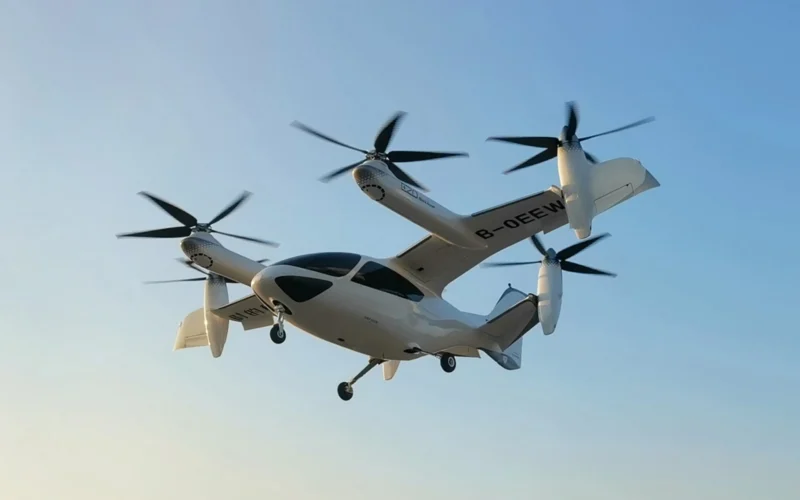
China has delivered its first domestically developed electric engine for an eVTOL aircraft, marking a step forward for the country’s advanced air mobility sector.
The Aero Engine Corporation of China’s Aeroengine Control System Institute developed the AEE25 engine and delivered the first unit in Wuxi, Jiangsu Province, on June 5, 2026.
The engine will power TCab Tech’s E20, a fully electric tilt-rotor eVTOL that can carry one pilot and four passengers. TCab lists the eVTOL aircraft with a range of 200 kilometers, a maximum speed of 320 kilometers per hour, and a 450-kilogram payload.
According to Chinese state media, the AEE25 is a 200-kW-class electric engine with a torque density of 40 newton-meters per kilogram, the highest publicly disclosed figure among Chinese aviation electric engines in this class.
The engine converts battery power into thrust for the aircraft’s rotors. It combines the main motor, cooling-system motor, variable-pitch actuator, and their controllers into one unit. The system also uses duplicated motors and dual-channel controllers to maintain power output after a single-point failure.
The AEE25 has now entered the airworthiness certification process with the E20 program. TCab expects the E20 to complete certification in 2027, although Chinese regulators have not yet issued a final type certificate.
TCab has already completed several E20 milestones, including full-scale flight testing in 2023, structural validation in March 2025, a manned flight test in October 2025, and transition flight tests in December 2025.
If the AEE25 secures certification with the E20, it would give Chinese eVTOL manufacturers a domestic propulsion option and reduce reliance on foreign electric motor suppliers.