

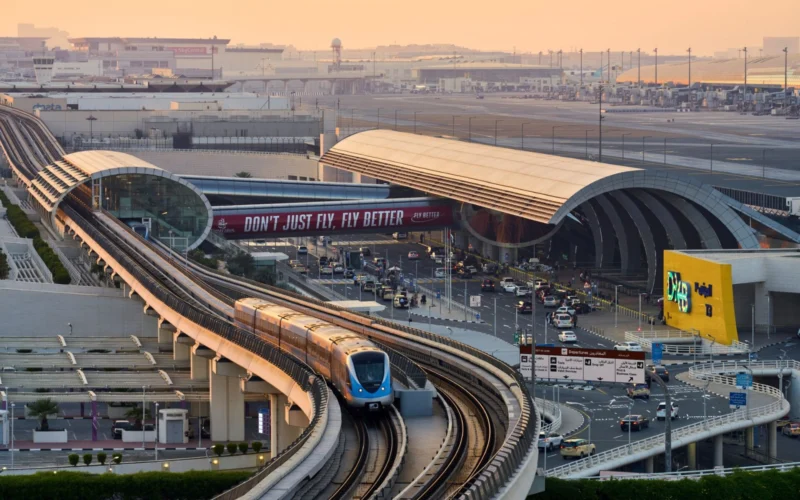
Dubai International Airport (DXB) is preparing for a surge in demand as UAE airspace restrictions ease. Through weeks of regional disruption, the hub kept operations running, handling six million passengers, over 32,000 aircraft movements, and 213,000 tons of cargo.
With UAE airspace now fully restored, Dubai Airports is scaling up flight movements and working with airlines to bring schedules back to normal.
Over the past two months, we’ve stayed focused on keeping the world moving. With #UAE airspace now fully restored, we are scaling up operations, increasing flight movements in line with available regional routing capacity and enabling airlines to progressively restore their… pic.twitter.com/dkSPtl2SOQ
— Dubai Airports (@DubaiAirports) May 4, 2026
Navigating unprecedented disruption
The disruption began on February 28, 2026, and intensified through March 2026, forcing DXB to operate under constantly changing conditions. Flight schedules, passenger flows, and ground handling had to be adjusted continuously based on available airspace.
Despite the constraints, the airport maintained safe and consistent operations through close coordination across its network of airlines, service partners, and control authorities. Emirates and flydubai, both based in Dubai, played a key role alongside international carriers in keeping traffic moving.
Paul Griffiths, CEO of Dubai Airports, called the situation unprecedented for a hub of DXB’s scale.
“The extraordinary events of the past few weeks are unprecedented for any major airport hub such as DXB,” Griffiths said. “Maintaining the smooth operation of DXB is therefore critical to keep global journeys moving. Our focus has been on keeping operations safe and consistent for our customers through close coordination and rapid decision-making across the entire airport community and beyond.”
Why DXB matters globally
Dubai’s position as a global aviation hub is tied closely to international transfer traffic.
Of the 99.3 million passengers whose journeys could route through the Middle East, the region captures around 70%. DXB alone handles 32% of that traffic, with 22.4 million annual passenger journeys passing through the airport on connecting flights.
That volume represents roughly one-third of all transfer traffic across Middle Eastern hubs. As conditions stabilize, this segment is expected to recover quickly, since the demand cannot easily be absorbed by airports elsewhere.
“Our collective response to these challenges has sharpened our ability to adapt at pace,” Griffiths said. “That readiness will enable us to accommodate returning demand as capacity is restored, reinforcing DXB’s role as a leading global hub, even as some regional routing constraints remain.”
Q1 2026 traffic hit hard by disruptions
The impact of the airspace restrictions is visible in the numbers. DXB welcomed 18.6 million passengers in the first quarter of 2026, down 20.6% compared to the same period last year.
March was particularly difficult, with just 2.5 million passengers passing through the airport, a 65.7% drop year-on-year.
India remained DXB’s largest source market with 2.5 million guests, followed by Saudi Arabia at 1.3 million and the United Kingdom at 1.2 million. Pakistan rounded out the top markets with 918,000 passengers.
London was the busiest city destination with 752,000 guests, followed by Mumbai at 520,000 and Jeddah at 505,000.
Cargo volumes reached 399,600 tons in Q1, down 22.7%, with 66,000 tons handled in March. Aircraft movements totaled 88,000 for the quarter, a 20.8% decline from the previous year.
Baggage handling under pressure
The disruption also affected baggage handling. DXB processed 17.6 million bags during the first quarter, including 2.6 million in March 2026. The mishandled baggage rate rose to 3.5 per 1,000 passengers, up from 1.95 per 1,000 in the same period last year.
For context, the global industry average sits at around 6.3 mishandled bags per 1,000 passengers, meaning DXB still performed well below that benchmark despite the challenging conditions.
Dubai Airports said its outlook for the year remains supported by strong underlying demand. As airspace capacity continues to improve, the airport is actively increasing flight movements and working with airline and airspace partners to unlock additional capacity.
Long-term expansion plans at Dubai World Central – Al Maktoum International (DWC) are also moving forward, supporting Dubai’s future growth as a global aviation hub.