

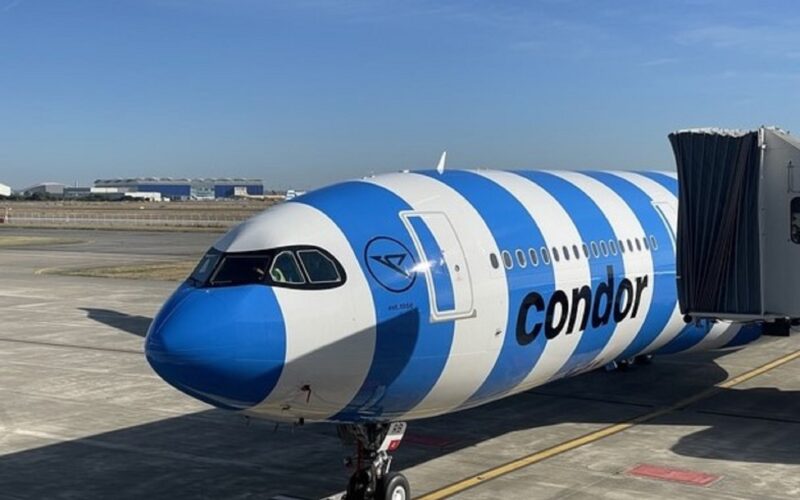
The European Aviation Safety Agency (EASA) has approved a modified Airbus A330neo (A330-900) that operates with enhanced features.
EASA published details surrounding the new certification on April 9, 2024, with Airbus later confirming the first entry into service of the modified A330neo would be with the German carrier Condor.
Airbus said the new incremental package, known as ‘Step-4’, would be available as a line fit option for new A330neo customer deliveries with the benefit of “improved performance and versatility”.
The package comprises the following three main features:
- Enhanced Take Off Configurations (ETOC) – which provides the pilot with additional flap positions.
- Faster landing gear retraction sequences with updated landing gear and doors actuators.
- Automatic Landing Gear Door Opening (ALGDO) – which, if an engine failure is detected during the take-off run, automatically commands the landing gear doors to open one second after the aircraft becomes airborne.
“These functions focus on enhancing the aircraft’s low-speed performance. This is achieved by further maximizing lift and reducing drag during the take-off and initial climb segments,” a spokesperson for Airbus said.
The benefits for operators include significant extra takeoff-weight uplift capability which translates into up to six metric tons more revenue-generating payload and/or range-increasing fuel in some airports and around 2.6 metric tons on average over the airports most flown by widebody aircraft.
“At other, even more runway-restricted airports, the net gain could be as much as seven tons – without increasing the engines’ thrust,” added the spokesperson.
A total of 175 flight test hours were conducted to evaluate the modifications, assessing takeoff accelerations, climb capabilities, flight control and handling qualities, system robustness.
There were also over 630 simulator sessions performed to analyze pilot handling, system integration, and safety compliance.
2 comments
So does the new ALGDO system sense weather conditions such as freezing temperatures and make any go/no-go decision on automatically opening the landing gear doors adding to the potential for degrading single-engine climb performance?
Is the landing gear door operation so slow that normal operation in retracting the gear is this critical of a problem?
How did it meet original certification if it cannot reconfigure for a V2 climb-out safely?
Any other surprises that the aircraft decides, where pilot input is not necessary?
does the landing gear hydraulics demand interfere with the actuation or operation in any other critical flight control or secondary controls during a V2 operation?
There seems to be more to this story, and why Airbus feels the need for yet another system change like opening the landing gear doors in the midle of a critical phase of flight. What motivated this change?
The original ALGDO function was developed for A350 as one of a selection of LG modifications to improve LG retraction time and get the A/C to clean configuration. The benefit being improved take off/climb performance thus enabling you have a greater MTOW than you were originally certified for, plus meet the obstacle clearance requirement for certain airports.