

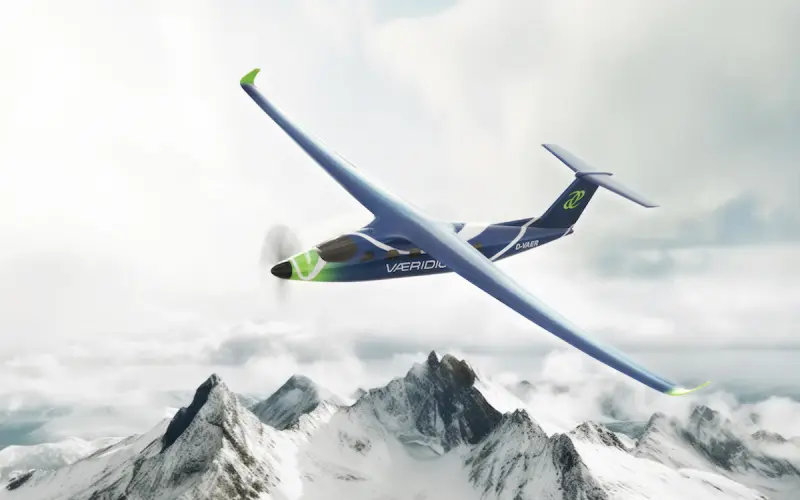
Munich-based startup Vaeridion announced on December 19, 2024, that it has raised €14 million to fund the further development of its future all-electric, battery-powered Microliner aircraft.
The Microliner, a conventional takeoff and landing aircraft designed to carry nine passengers over distances of up to 500km, is expected to be ready to enter service by the end of the decade.
Vaeridion was founded in Munich by Dutch aerospace engineer and Airbus veteran Ivor van Dartel with the goal of electrifying regional air mobility.
The new funding round has been led by World Fund with participation from of other investors such as Vsquared Ventures, Project A, Sterling Concorde, Schwarz Holding and InnovationQuarter.
The additional funds add to a previous €3.4 million seed round and, together with financing secured through government support programs, takes the total amount raised to date by Vaeridion above the €18 million mark.
In November 2024, Vaeridion became the first general aviation company to successfully complete a Pre-Application Contract (PAC) with the European Union Aviation Safety Agency (EASA). This program enables aerospace startups to engage with the European aviation regulator from an early stage to clarify the certification requirements and de-risk the development risks of their projects.
1 comment
I cannot help but notice all of these “New” entrants into the transportation market like to quote entry/start dates, ranges, speeds, etc., into their press releases, and editors continue to write in their articles similar details.
Is it just me, or do others stop and wonder how any details can be suggested or specified when there are no regulations or rules yet for these new breed of hopefuls?
What is range when a battery has no comparison to a carbon fuel burn rate and calculations to “empty tanks”, and then backing off for alternates, winds, etc?
What about density altitude and the usual aerodynamic considerations? Have all of these basics/standards been scrapped since electricity is the power source?
What weather can these new breeds fly in safely? How do they fair in the lightning strike testing lab, or have we not performed any of these tests yet? Static electricity effects, when flying in “dirty” low altitude air where more abrasives come in contact with the propellers, rotors, or turbine blades?
Are these new spider web looking vehicle surfaces going to react the way they need to in a crash or hard landing? What effect does the loss of a propeller/rotor have on the rest of the system? Bird strikes? Honey bees coating the entire mass of rotating blades operating in such close formation?
I see a lot of positive dreams around these new flying machines, but very little if any “real life” questions being raised, discussed, or addressed.
And right now portions of the US and its populations have lost their minds over a few drones flying around at night, when the current drone news in the industry, and in the flow of investors money is pointing towards 100’s and 1,000’s of drones zipping around all over the place, in the middle of large cities like airborne UBER’s.
Just wondering for a friend…