

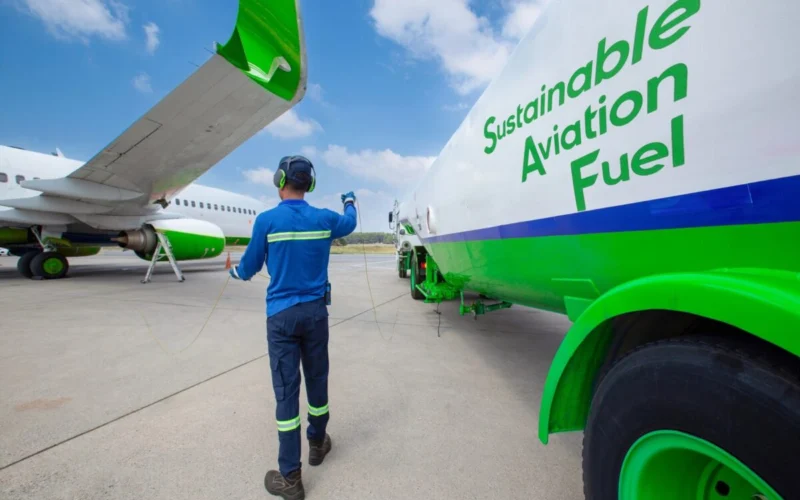
A bipartisan group of US lawmakers has introduced a bill that would restore and extend a key federal incentive for sustainable aviation fuel (SAF), aiming to stabilize a sector that developers say has been shaken by shifting policy. The Securing America’s Fuels Act introduced in the House would reinstate the higher, SAF-specific rate within the Clean Fuel Production Tax Credit and extend it through 2033, providing a tax credit of $1.75 per gallon for qualifying producers.
Congress had extended the broader clean fuel credit earlier this year but removed the bonus rate for SAF, a change that caught many in the industry by surprise. SAF developers warned that without the higher credit, financing for new plants would become more difficult.
Some projects were paused almost immediately, and others were pushed into “wait and see” mode. Supporters of the new bill say it offers the long-term clarity producers need to resume construction and move ahead with expansion plans.
Sustainable aviation fuel is a drop-in replacement for conventional jet fuel that can be used by today’s aircraft without modification. It is produced from a range of feedstocks, from agricultural waste to used cooking oil, municipal waste streams and, in the case of e-SAF, synthetic fuels created with renewable energy and captured carbon.
SAF can reduce lifecycle emissions compared with fossil-based jet fuel, making it central to the aviation industry’s decarbonization plans. But supply remains extremely limited, and production costs are far higher than traditional fuel.
Those limitations are front of mind for airlines. At the International Air Transport Association (IATA) Media Day on December 9, 2025, Director General Willie Walsh warned that global SAF production is nowhere near meeting demand and that even the industry’s 2030 goal of 10% SAF use now appears out of reach.
Walsh argued that the barrier is not willingness to buy the fuel but the lack of availability. He also criticized the European Union’s mandates, saying they have pushed up prices without delivering the supply needed to meet airlines’ commitments.
Lawmakers behind the new US bill say the updated tax credit is aimed at addressing that problem. Rep. Mike Flood of Nebraska said the measure would help drive a new “biofuels revolution” and support rural economies that supply feedstocks. Rep. Sharice Davids of Kansas said producers, farmers, and airlines need long-term policy signals so they can plan investments with confidence.
Industry groups have welcomed the bill. Airlines for America, the Sustainable Aviation Fuel Coalition, and the National Business Aviation Association all issued statements supporting the move, saying the extended credit gives producers the predictability they need to build out capacity. NBAA President and CEO Ed Bolen said restoring the full rate “provides the clarity and stability needed to unlock investment, expand supply and accelerate progress.”