

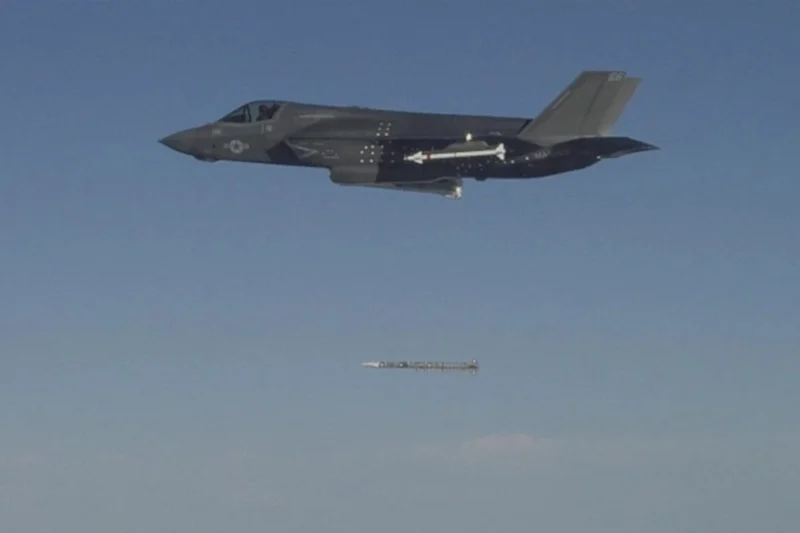
A Lockheed Martin F-35B has released an MBDA Meteor beyond-visual-range air-to-air missile test asset from its internal weapons bay for the first time, marking another step toward integrating the European weapon on British and Italian Lightning II fleets.
The trial took place on October 7, 2026, at Naval Air Station Patuxent River, Maryland, according to the F-35 Joint Program Office (JPO). The JPO and MBDA announced news of the test on November 5, 2026.
F-35B demonstrates safe Meteor separation from internal weapons bay
The test was a jettison, not a live missile firing. According to the JPO, the weapon test asset separated from the aircraft without igniting its rocket motor or activating its control surfaces.
Such trials are designed to verify that a missile can leave an aircraft safely, either during normal operations or in an emergency, without striking the fuselage, damaging wing structures or affecting the aircraft’s flight dynamics.
Both organizations declared that the test had demonstrated safe separation in the complex aerodynamic environment around the F-35B’s internal weapons bay. The data collected will be used to refine digital models that predict how the missile will behave during release.
A combined UK/US F-35 Integrated Test Force (ITF) team, including Royal Navy, Royal Air Force and Lockheed Martin personnel, prepared and loaded the test asset. A Royal Navy test pilot, assigned to the UK’s Air and Space Warfare Centre and embedded in the ITF, flew the sortie.
Meteor integration advances toward live missile firings
According to MBDA, further release trials are due to take place over the coming months to verify safe separation under different flight conditions. The campaign will eventually move to live firings, testing both the missile’s separation from the aircraft and its flight performance after release. Neither MBDA nor the JPO has provided dates for those tests.
The latest trial follows the first flights of an inert Meteor aboard a US Marine Corps F-35B from Patuxent River, announced by the Royal Air Force in February 2025. These flights gathered environmental data without releasing the missile.
Work has also progressed on the conventional-takeoff F-35A. On December 3, 2025, Lockheed Martin announced that ground vibration testing and fit checks had been completed at Edwards Air Force Base, California. One ground test remained before the aircraft could begin flight testing with Meteor.
The UK leads Meteor integration on the F-35B, while Italy sponsors the F-35A effort. Both countries also operate the F-35B.
Meteor is already in service on the Eurofighter Typhoon, Dassault Rafale and Saab Gripen. Its ramjet propulsion system provides sustained thrust during flight, distinguishing it from conventional rocket-powered air-to-air missiles. Germany ordered additional Meteor missiles in January 2026.
UK expects Meteor capability on F-35B in early 2030s
Despite progress in testing, Meteor is still several years away from entering service on the F-35.
In a written parliamentary answer on April 20, 2026, UK Minister for Defence Readiness and Industry Luke Pollard confirmed that the US-led F-35 JPO was overseeing Meteor integration on the F-35B. He noted that the estimated timeline for the missile to enter service on the aircraft still points towards the early 2030s.
Meanwhile, London is already looking beyond Meteor. In April 2026, the UK and France launched a 12-month joint study into a next-generation air-to-air missile that could eventually replace it.