

The eVTOL industry – or the low-altitude economy, as it is known in China – has been generating headlines for the best part of a decade.
Promises of urban air taxis, point-to-point regional travel and zero-emission flight have already attracted billions in investment and spawned dozens of startups worldwide. For every aircraft that has graduated from concept renders to actual flight, though, many more remain grounded, no more than ideas on paper.
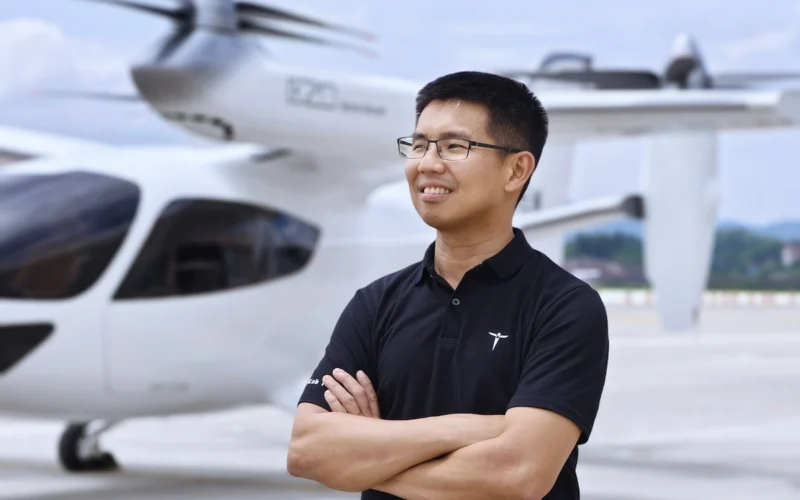
TCab Tech, a Shanghai-based eVTOL developer, has taken a deliberately engineering-led approach to this challenge. Rather than chasing complexity or spectacle, the company has consciously chosen to keep a relatively low public profile, focusing all its energies on developing a technically sound, versatile platform, with operating economics that make its E20 eVTOL a very competitive contender in the advanced air mobility sphere.
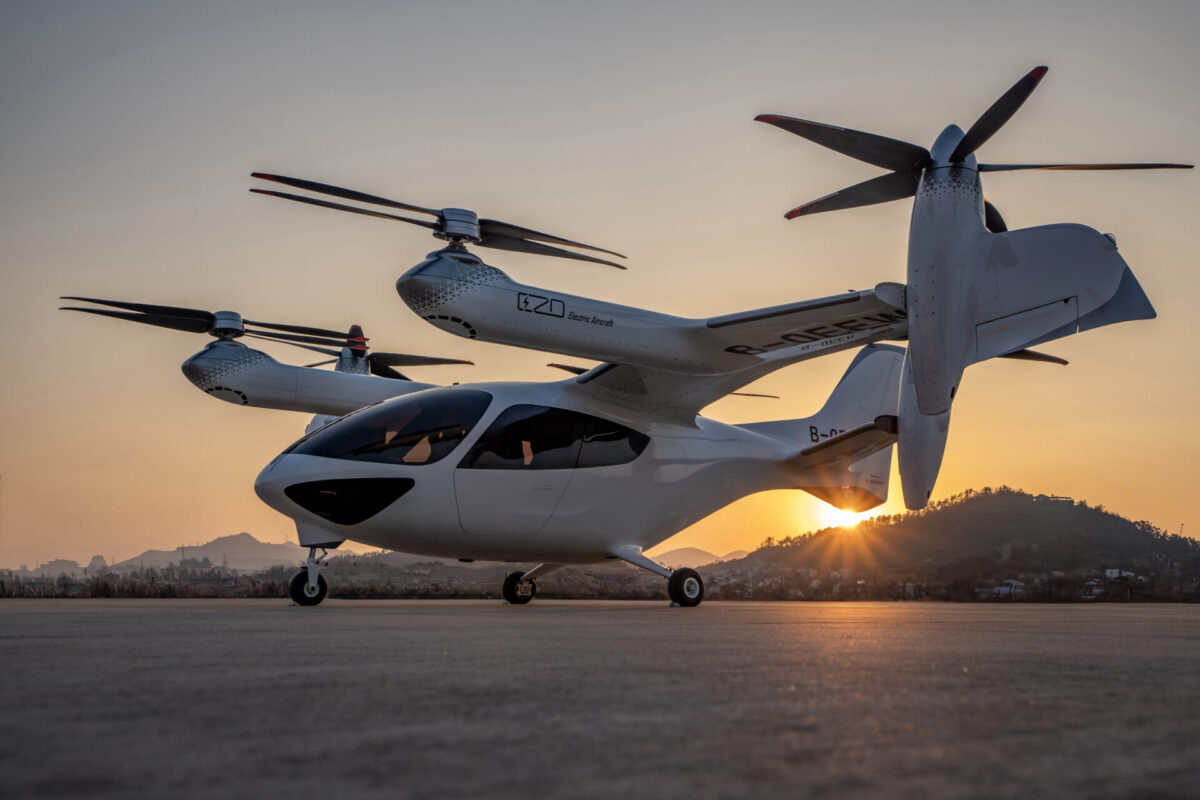
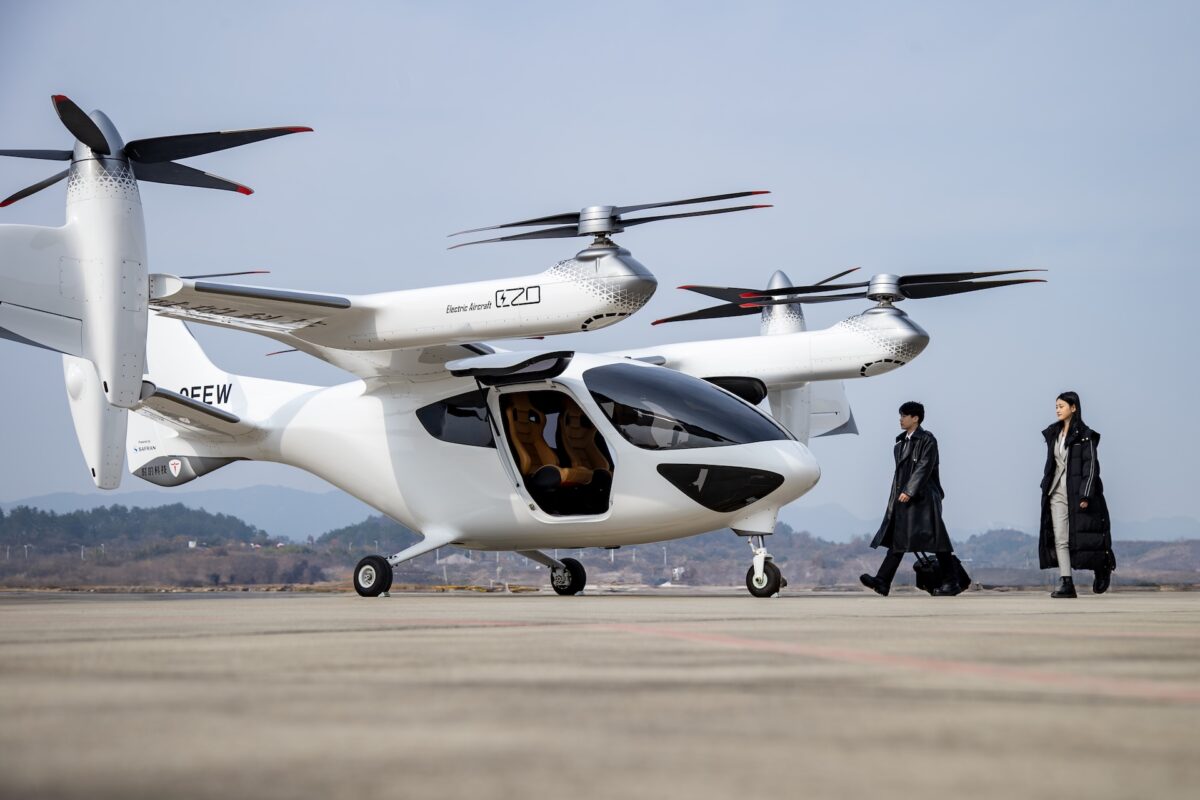
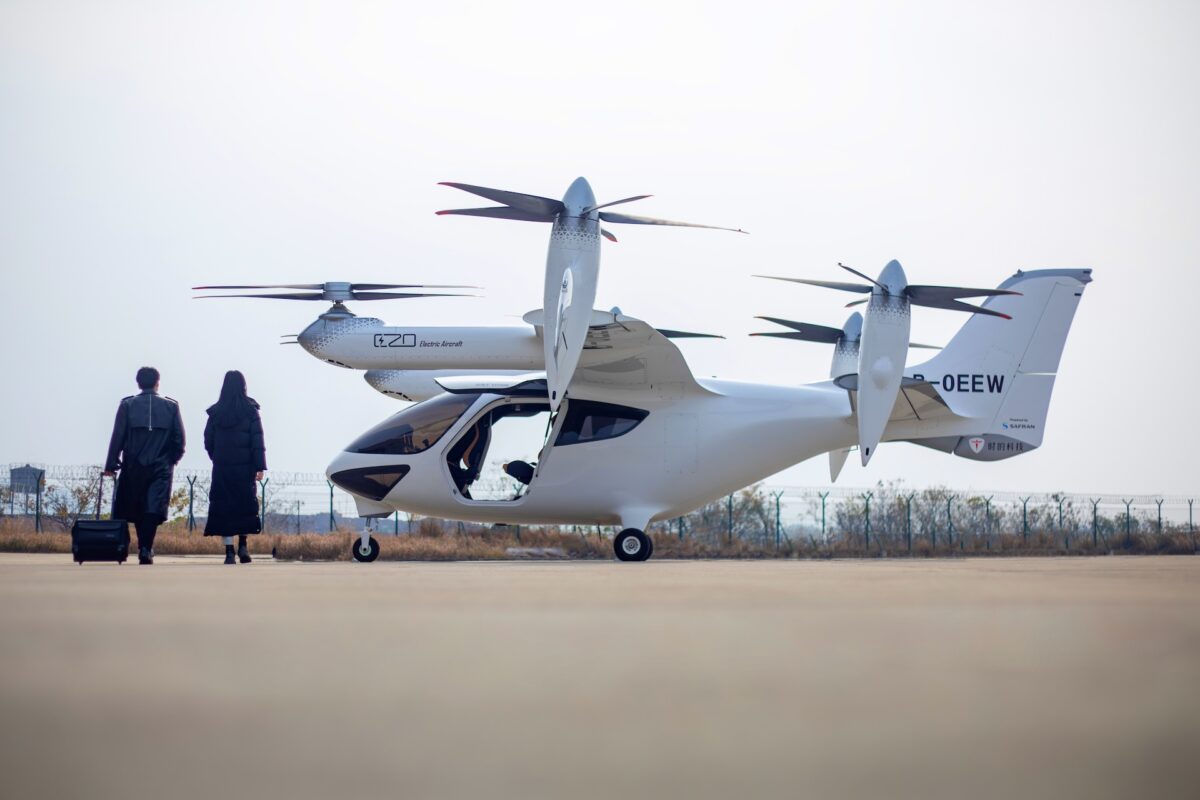
The E20 is a five-seat tilt-rotor eVTOL, capable of carrying four passengers plus a pilot while cruising at 260 km/h and achieving a top speed of 320 km/h and a range of 200 kilometres.
Those are not aspirational figures: the E20 has logged over 1,000 flight tests since its maiden flight in 2021. What’s more, in 2025 it completed its first crewed transition flight, with founder Yon Wui Ng onboard. Currently, it’s undergoing the compliance verification stage to obtain its type certification from the Civil Aviation Administration of China (CAAC).
In fact, the company recently reached a significant regulatory milestone, with the completion and acceptance of its G2 Means of Compliance. which defines how TCab will demonstrate compliance with the certification basis agreed with the Civil Aviation Authority of China (CAAC).
We spoke with Yon about TCab’s engineering philosophy, where the E20 stands in its certification journey, and what it will take to turn the low-altitude economy from a policy design into a daily reality.
The founder’s story
TCab’s founder, Yon, has a CV that is anything but typical for a startup founder.
Originally from Malaysia, he built his career on a truly multi-national trajectory, moving first to Singapore, then to Australia where he completed his aerospace engineering studies, before moving to China to join Airbus.
He eventually rose to become Chief of Engineering for Airbus Operations in China, a country in which the European aircraft maker has a substantial footprint, operating one of its major assembly lines for A320-family airliners in Tianjin.
Next, Yon moved to Terrafugia, an early eVTOL developer backed by Chinese automotive giant Geely, where he took on a senior executive role.
This role gave Yon a front-row seat from which to witness the emergence of the new eVTOL industry.
“Around 2018, when I first joined Terrafugia, I realised that eVTOL was already showing some real potential,” he recalled. “That got me thinking about what the most viable technical path would actually look like.”
Yon eventually left Terrafugia to found TCab in 2021, with the goal of building a mode of transport that was both innovative but realistically achievable within a reasonable time frame and budget.
“We started from the end goal and worked backwards,” he explains. “We wanted an aircraft that could be five times faster than ground transportation, without the operational cost of a helicopter.”
This approach, encompassing innovation, performance and affordability, became the blueprint for the E20.
Leveraging China’s supply chain
Speaking with Yon, one thing becomes clear: TCab is not designing a fancy, expensive toy, but rather a real aircraft capable of performing its missions flawlessly and affordably.
“Our approach is to ensure that we can have an air taxi that can be used by the general public,” he said. “So, one of the key factors is that it has to be cheap. It has to be much cheaper than a helicopter. The end goal is to be able to keep our aircraft price low and achieve our target of 3 to 4 Yuan per passenger and kilometer [US$0.5 approximately – ed. note]. This is our target.”
Similarly, Yon is targeting an overseas price tag for the aircraft of around US$3 million, which compares favorably with the tentative price ranges floated for their aircraft by some of the most prominent Western eVTOL makers.
To be able to achieve this ambitious goal, Yon is counting on the breadth and depth of China’s industrial supply chains.
“We looked into some of the solutions proposed by our competitors and very quickly realized they were not going to be cheap. That would not be helping in the commercialization. So, this is when the Chinese supply chain kicks and in a very good way. Comparing the US, Europe and China, we quickly realized that in China, we have a very good EV supply chain, motors, batteries, systems… especially when it comes to batteries.”
Yon attributed the development of the Chinese aerospace supply chain in great part to the work of COMAC, the state-owned aircraft maker.
“As an OEM in China, we can concentrate on aircraft integration activities. We don’t have to become very good at everything, because suppliers and partners work with us for different kinds of motors, propellers, flight control systems, batteries, and so on and so forth. So, this is one of the key advantages. This way, we’ll be able to reduce our R&D expenses,” he explained.
A leader in the dynamic Chinese eVTOL scene
TCab has also found a reasonably receptive environment in China for the nascent eVTOL ecosystem, with different levels of government laying out policies that are supportive of eVTOL research and development (R&D) in general. These policies often relate to the building of dedicated infrastructure, the opening of airspace and the setting up of a regulatory framework.
“We are not involved in any particular government project – at the moment, there aren’t that many eVTOL sandbox projects in China yet – but we are, of course, active in what we could call ‘standards building’ for infrastructure and for airworthiness certification (certification standards) . For example, the certification basis which we are currently undergoing for our eVTOL aircraft is becoming the standard for the industry. We are also participating in the definition of infrastructure standards through our collaboration with the government.”
With the Chinese authority leading the way in advanced air mobility, Yon expects these standards to be adopted subsequently by other countries in Asia, paving the way to TCab’s future regional expansion.
“This has already started,” he said. “Why am I saying that? Because eVTOLs are a new product and in the past, there weren’t any standards. But there are different kind of eVTOLs in China that already acquired certification.”
To illustrate this point, Yon mentioned fellow eVTOL developers, EHang and Autoflight, which have each received some restricted types of certification already. The former has received certification to fly passengers on sightseeing flights under certain conditions, while the latter has been certified for certain cargo missions.
“CAAC certification experience is increasingly referenced by other markets, especially in Asia, when they assess Chinese eVTOL product,” Yon added.
Laser-focused on getting the basics right
If there is one thing that Yon is obsessed about, it’s design and process efficiency, particularly with when it comes to optimizing the aircraft’s architecture, so as to limit the potential points of failure, and limiting its weight, making sure there is not a single gram too many.
“This is just a typical principle of aircraft design, because weight is always a killer for an aircraft design. In our situation, eVTOL is an electric aircraft. The battery already weighs 600 kilos by itself. So, if we do not look into weight reduction programs, the aircraft is most likely not going to be able to carry any payload. That means you cannot carry passengers, and that means there is no commercialization or commercial value at all,” Yon explained, before further elaborating on his company’s engineering-led pproach to design optimization.
“I wouldn’t say that I’m creating an efficient machine, it’s more that we are making sure that we get the payload we would like to have. And, in this, we are doing pretty well. Basically, we are able to carry 450 kilos for the 2.6 tons maximum takeoff weight. This is thanks to our entire team, which has been saving weight from different kinds of systems, from structures to avionics, through electric propulsion systems to EVs.”
In this regard, Yon expressed his skepticism about the claims of other eVTOL developers and contraposed what he thinks are often over-optimistic promises to TCab’s realistic approach.
“I think many projects around the world are promising some kind of aircraft performance, while in reality we have not seen too many of them delivering while carrying payloads. We are one of the earliest to carry two people, and that means something. What is most important is that we are able to carry payloads on our aircraft.” said Yon, referring to the piloted flight tests TCab carried out in 2025, with two people onboard, himself included.
Yon reiterated his patient but relentless approach to delivering one milestone at a time.
“Flying is one achievement, but flying and being able to achieve the targeted range, endurance and speed is another thing. I think we need to first ensure that the aircraft can fly. And secondly, we need to ensure that the aircraft can carry five people in our case, four passengers and a pilot, plus the luggage. Our target is 80 kilos per person and then 50 kilos for the total luggage weight. This year we will move toward flight tests with the equivalent payload of five people onboard.”
How does TCab combine the necessity to build an aircraft as lean as possible and at the same time providing enough redundancy for safety?
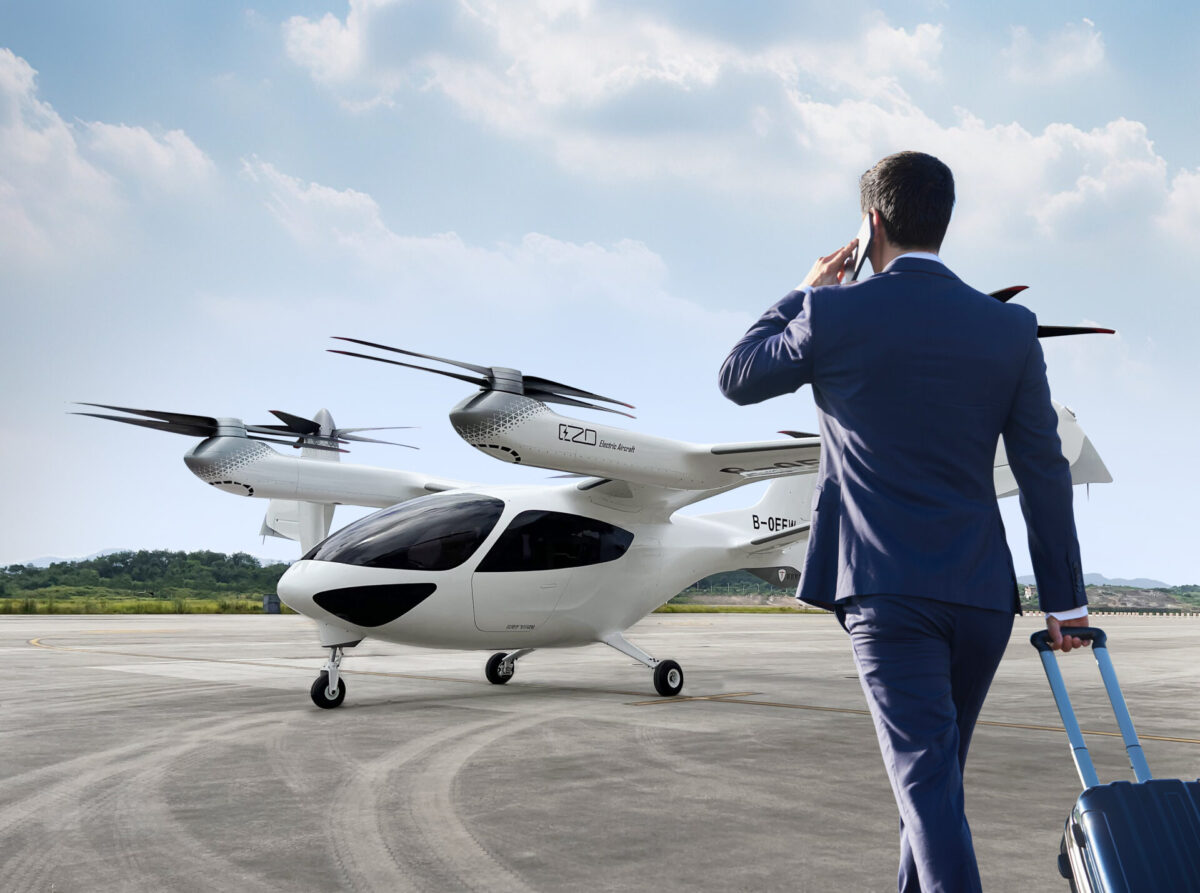
“We are initially focused on piloted passenger transport, rather than trying to certify multiple mission types at the same time. The E20 is designed as a VTOL aircraft, not as a runway-dependent aircraft.” explained Yon.
“Secondly, we design to meet applicable certification and safety standards, while avoiding unnecessary complexity that does not add safety or operational value. At an early stage, when finalizing our concept design, we went through different technologies, combining or integrating different systems together. For example, selecting the same kind of voltage for our avionics and electric propulsion systems, selecting the same kind of harnesses for EVs, and so on.”
Yon highlighted once again that one of the core concerns of his team is to make the aircraft as light as possible without compromising on the performance specifications.
“Of course, all in all, tilt rotor configuration is a good one to go with, because basically you reuse your propulsion system from vertical lift to horizontal thrust and that is also helping to keep the weight down.”
When it comes to the propulsion system, Yon does not appear concerned about the hypothetical complexity of the tilt-rotor mechanism that TCab has opted for.
“Many people will say that it includes a lot of complexity, but at the end of the day, we just need to use linear actuators to move the propellers from 90 degrees to horizontal. If we compare that to another configuration, which is lift plus cruise configurations, you’re going to have two sets of electric propulsion systems. That means adding another set of rotor, motor and EVs, which are the harnesses that you need to use, so it is actually much heavier than our solution.”
From prototyping to production
As of May 2026, while it prepares for the next stages of its flight test program, TCab is building its conformance aircraft for the certification process.
TCab aims to receive certification for the E20 in 2027.
“We are still on target,” Yon said. “At the moment, we hope that we’ll be receiving our Type Certification (TC) by the end of 2027, then a few months after that, by 2028, we’ll be able to enter into service.”
If this timeline is fulfilled, TCab expects to produce 200 aircraft at a 10-acre plant currently being built. Part of the facility is already completed and in use, with the rest expected to be ready by the end of 2026.
Another aspect of the future rollout for which TCab is also thinking ahead is pilot training:
“In the meantime, we have also built up our training capability, because we need to ensure that we have pilots for our launch customers. So, we’ll have the flight simulators ready by the end of this year, and by the next one, our first batch of recruited pilots will be able to train on the simulators – and later, in late 2027 or early 2028, on the aircraft. So that will be the two main parts of commercialization. On one hand, to provide the aircraft, on the other hand, the trained pilots as well,” Yon explained.
TCab plans to take care of pilot training particularly at the very beginning of the rollout process:
“I think we need to ensure that the launch customer will be able to kick start with their projects and we need to handle the pilot training for them. In the future, we’ll be looking for our partners for this particular aspect as well. For example, we are working with the Flight Academy of China, and they will be able to supply pilots for the industries.” explained Yon, adding also that most of the initial E20 pilots will have some form of previous experience.
“At the moment, our plan is to get pilots who already have a license for Part 27 helicopters or Part 23 fixed-wing aircraft, so they have to be commercial pilots for either fixed-wing aircraft or helicopters to start with. Then, on top of that, they will need 50 to 100 hours of training, approximately. So, we won’t train them just from scratch. If someone starts from scratch, most likely it will take something like a couple of hundred hours.”
Commercial rollout and market feedback
TCab has built a commercial pipeline covering more than 1,000 aircraft through a combination of purchase orders, framework agreements, MOUs and letters of intent.
“At the moment, there are two or three main types of customers. The first profile is for sightseeing. Why didn’t helicopters work for them in the past? Because helicopters may come with pollution or the price is expensive. Our early launch customers also involve people or governments, or state-owned enterprises that have access to the tourist spots,” he noted.
“The second profile is helicopter operators in China or around the world, whether they are doing sightseeing or some short haul kind of flights. And the last type is the state-owned companies that would like to be part of the low altitude economy in China.”
“Because we are in Shanghai, we are working closely with the local Shanghai authorities and the surrounding cities about how we’ll be able to set up the inter-cities routes – for example, from Shanghai to Zhoushan, Ningbo or Hangzhou, these sorts of routes. There are a few studies about China and 70% of movements are within 150 kilometers.”
Would TCab consider hybrid architectures for extended range?
Yon has a very well-defined opinion on this matter, too.
“At the very beginning of our venture, we studied different kinds of technology paths and realized that a hybrid, either with hydrogen or with the conventional engine, is not going to work quite as well. I wouldn’t say that it wouldn’t work. but that if we would like to make our end goal happen, which is sightseeing and inter-city travels, then maybe this is not the best solution at the moment. The hydrogen is still not matured in terms of technology, and the conventional engine is not really adding any benefits in terms of weight and safety. So, I think for a five-seater eVTOL, the best solution remains full electric.”
Yon didn’t close the door on further propulsion developments in the longer term, though,
“In the future, after we have completed our certification for these existing aircraft, then mostly we’ll move on to hybrid, but it will likely be a larger aircraft, not just a five-seater.”
What about electric charging and the infrastructure?
Another point in favor of going electric, according to Yon, is the already extensive electrification of the Chinese economy.
“In China we have no problem because EV cars are already very common and charging facilities are also common. We are using exactly the same kind of charging infrastructure as EV cars and so there’s no problem for the power grid either.”
Yon acknowledged this may not be the case in other geographies, though:
“China is not a problem. Then, moving into Southeast Asia, I think at the moment, some of the Southeast Asia countries, yes, they do need to provide the power grid and so on to ensure that it will work. But nowadays, there are different kinds of solutions for that. For example, you can use battery storage to improve the power of the grid. That is one of the ways that we realize that is a good solution, because it will minimize the investments that we need for the infrastructure.”
Much in line with TCab’s engineering-led take on advanced air mobility, Yon backs a cost-efficient approach to eVTOL infrastructure.
“Actually, I am against making very futuristic vertiports. I think it is not really a good way of commercialization, because every cent that we spend on infrastructures needs to be paid, right? We should just use a typical helipad and put another two charging stations on it, and that’s it. Also, whoever that is going to be using our service, they are in a rush to go to their destination. They don’t want to come here and drink coffee. They want to go, they want to move, so if they want to drink coffee, they can go to a hotel and have their coffee there.”
After all, one of the promises of eVTOLs is to be able to take people from pretty much any one place to another.
“In terms of infrastructure, I think the smallest type of vertiport has to be just like a bus stop, so to speak – basically just a helipad, about 25 meters in diameter, with two charging stations. Then, if you want a small waiting area, that will do. And that’s it. That’s what we need for a vertiport.”
Yon is also in favor of re-purposing existing infrastructure wherever possible.
“The second type, a little bit larger, is what in China we call the rooftop of a parking lot or of a shopping mall. And the last one is the most interesting one – the rooftop of the long-haul bus station. Why? Because in China, bullet trains have already become so common that no one is going to the long-haul bus stations anymore and all of these buildings are now deserted. So, the government is keen to look for a new way of using them, because they are its property. We will be very soon seeing that in Shenzhen – the long-haul bus stations will be renovated, with the rooftop becoming our eVTOL vertiport. And that makes sense, because we cannot rebuild infrastructure, we must use what already exists. I think this is the most realistic way.”
Overseas expansion
TCab is also looking overseas. In particular, it has two regions on its sights, with the company envisaging the same use cases as in China.
The first Southeast Asia, where its founder’s native country, Malaysia, appears as one of its most promising markets. The other is the UAE, with TCab currently working with local partners in view of a potential launch in either Abu Dhabi or Dubai.
“We signed an MOU last year regarding the sale of aircraft. But of course, it is a difficult time now in the Middle East so there are uncertainties over there.”
“In whichever countries that we go into, we need to work with the certification body,” Yon concluded. “So, for example, in the Middle East, we have been working with GCAA, of the UAE, and they signed a MOU with the Civil Aviation Authority of China to be able to recognize the certification. We’re going to do something similar in Malaysia to ensure good penetration there as well. These are the activities that are ongoing overseas.”