

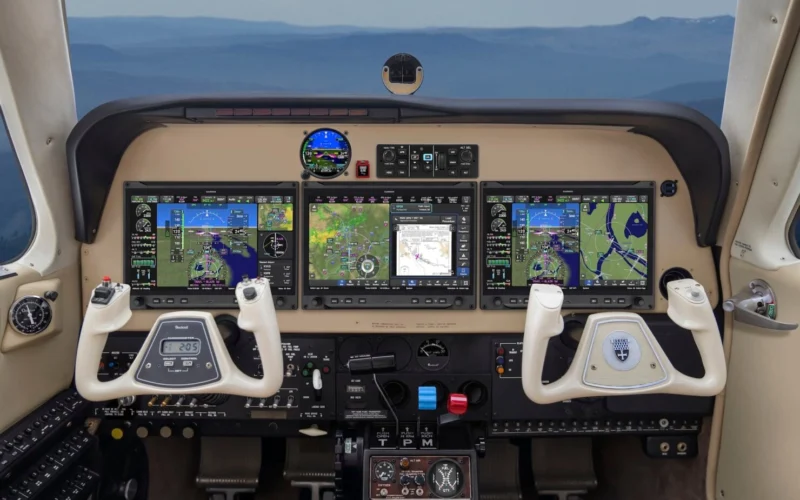
Garmin has unveiled AXIS, a new family of integrated retrofit flight displays designed to bring a big-screen glass cockpit experience similar in presentation to Garmin’s G1000 NXi flight deck to a wide range of piston aircraft.
The thinking behind AXIS is to reduce the number of separate avionics boxes needed in many general aviation retrofit panels by combining the display with IFR GPS, NAV/COMM radio and audio panel functions built into a single unit.
The concept is designed to free up panel space, reduce wiring complexity and installation time, and cut the overall cost of a panel upgrade, Garmin said.
AXIS can also slightly reduce aircraft weight while offering cockpit tools more similar to those found in fully integrated flight decks common in new aircraft.
Garmin announced AXIS on July 8, 2026. The system is aimed at certified piston-powered single- and twin-engine aircraft through an approved model list supplemental type certificate (AML STC) covering hundreds of models, as well as experimental and light sport aircraft under the FAA’s MOSAIC framework.
AXIS includes three display formats: an 11.6-inch landscape display, an 8-inch portrait display and an 8-inch landscape display. Each display can be configured as a primary flight display or multifunction display, with optional engine indication.
The key model is the 11.6-inch AXIS display, which can be ordered with a TSO-certified IFR GPS, COMM radio, NAV radio and audio panel built into the display.
Garmin said the integrated architecture creates a simpler and more cost-effective installation compared with panels that require separate navigators, radios and audio panels.
“AXIS redefines Garmin’s flight display portfolio and brings industry-first capability to a single flight display,” said Carl Wolf, Garmin Vice President Aviation Sales, Marketing, Programs & Support. “This game-changing flight display system delivers a modern, highly capable cockpit experience while significantly reducing time, complexity and cost of installation through integration of navigation, communication and audio functions into a single flight display.”
The VHF COMM radio provides 10 watts of transmit power, supports 8.33 kHz frequency spacing and includes standby COMM monitoring. The integrated audio panel includes a four-place intercom, dual-comm switching with support for one external radio, comm playback and Bluetooth capability for music and phone calls.
Garmin said the 11.6-inch certified displays will be available in three TSO variants: a base PFD/MFD version, a GPS/COMM version and a GPS/NAV/COMM version. Experimental and LSA aircraft can use both certified and non-TSO versions of the 11.6-inch displays.
AXIS also gives Garmin a new upgrade path for aircraft already equipped with G3X Touch displays. Garmin said AXIS is compatible with many of the same navigators, radios, modules and sensors as G3X Touch and can use the same panel cutouts and mounting points.
The displays use touchscreen controls along with physical controls for quick access to key functions. Pilots can run full-screen or split-screen views and use the displays as a PFD or MFD depending on the installation.
The PFD can show primary flight data, an HSI with embedded map or traffic view (a layout first introduced with G1000 NXi) and compact widgets for map, flight plan, weather, traffic and other MFD functions.
AXIS includes Garmin’s Enhanced Synthetic Vision Technology, showing 3D depictions of terrain, obstacles, runways, taxiway markings and other features. The system also includes pathway rectangles to show the aircraft’s programmed flight path, including enroute legs, flight track and course intercepts.
Garmin also included 3D SafeTaxi, giving pilots a three-dimensional view of the airport environment directly on the PFD.
The MFD side includes dynamic mapping, ADS-B traffic and weather with a compatible datalink, waypoint information, terminal charts and expanded engine indication. Each display also includes an HDMI input for live camera video.
AXIS supports several Garmin safety systems, including a dedicated emergency button on the display bezel, Smart Glide, Runway Occupancy Awareness and optional SurfaceWatch runway monitoring.
Smart Glide, part of Garmin’s Autonomí technology suite, helps pilots in engine-power-loss emergencies by guiding the aircraft toward an airport in range. If the aircraft is equipped with a compatible GFC 500 or GFC 600 autopilot, Garmin said the system can auto-engage to fly the aircraft enroute.
The engine indication system can serve as the primary EIS display in piston aircraft with most normally aspirated or turbocharged four- to six-cylinder engines when equipped with the required interface adapter and sensors. Garmin said AXIS can also support radial and turbine-powered experimental aircraft.
The system includes built-in Wi-Fi and Bluetooth, Garmin Pilot connectivity, a USB-C data port, Database Concierge and PlaneSync support through the GDL 60 datalink. PlaneSync can support automatic database downloads, remote aircraft status and automatic flight-log uploading with required subscriptions.
Garmin said its Team X experimental aircraft group helped shape AXIS for builders and experimental aircraft owners. The company said the system uses simplified wiring, additional built-in input/output capability and an upgrade path from G3X Touch using many existing sensors and LRUs.
The 11.6-inch AXIS displays have received FAA and EASA Technical Standard Order authorization and are scheduled to become available in July 2026. Garmin said the 8-inch displays are expected in early 2027.
The FAA STC is expected to cover hundreds of certified Part 23 Class I/II piston singles and twins. Garmin said approvals from other civil aviation authorities are expected later.
Garmin AXIS display pricing ranges from $8,000 for basic entry-level experimental setups to $23,400 for large certified, IFR-equipped units.