

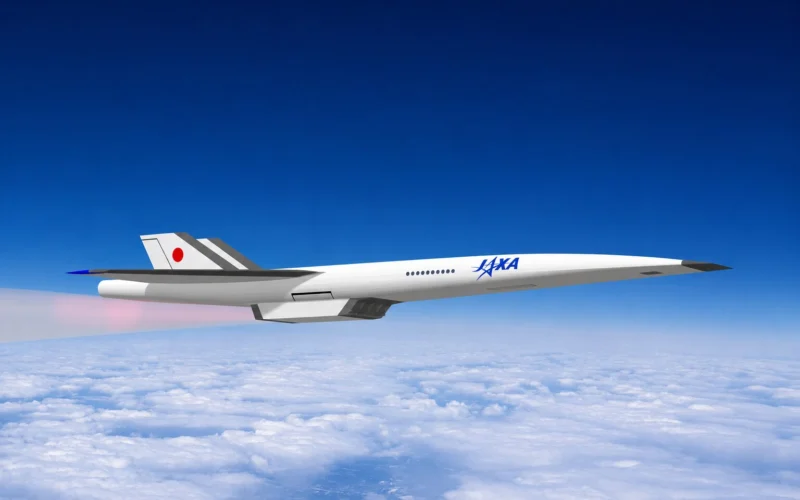
Japan has completed a ground combustion test of a ramjet engine for a Mach 5 experimental aircraft, marking a step forward in the country’s long-running hypersonic flight research endeavors.
The Japan Aerospace Exploration Agency, Waseda University, the University of Tokyo and Keio University conducted the test as part of a research project focused on integrated airframe and propulsion control for a hypersonic flight testbed.
The team installed the experimental aircraft in the ramjet engine test facility at JAXA’s Kakuda Space Center in Miyagi Prefecture. The wind-tunnel test simulated flight at Mach 5, or five times the speed of sound, and demonstrated the aircraft’s heat-shielding structure, control-surface operation and ramjet combustion under hypersonic conditions, according to JAXA.
At Mach 5, air temperatures around the aircraft can reach roughly 1,000 degrees Celsius. JAXA said the test aircraft’s thermal protection system kept the interior near normal temperatures, allowing onboard electronics used for control to operate normally during the experiment.
The team also measured surface temperature distribution to validate its thermal-structure analysis methods. Researchers said they measured exhaust-temperature distribution from the hydrogen-fueled ramjet to collect data on the potential environmental effects of future hypersonic propulsion systems.
JAXA said the aircraft was designed and built by the university and agency research team under a Japan Society for the Promotion of Science-funded project. The project focuses on building a hypersonic flight testbed using sounding rockets and demonstrating integrated airframe-propulsion control.
Hypersonic aircraft require a different design approach from conventional aircraft because the airframe and propulsion system interact closely at high speeds. Shock waves generated around the aircraft affect airflow entering the engine, while engine thrust directly affects aircraft motion. That makes the aircraft and engine a single coupled system rather than separate design problems.
The next step envisioned by the research group would place the experimental aircraft on a sounding rocket or similar vehicle for a Mach 5-class flight test.
JAXA said establishing hypersonic flight technology could eventually support aircraft capable of crossing the Pacific from Japan to the US in about two hours or spaceplanes capable of reaching altitudes near 100 kilometers.