
Joramco is preparing for its next phase of expansion, building on the success of Hangar 7 with two additional hangars planned in Jordan, a growing pipeline of aircraft maintenance engineers and new digital technologies designed to make its operations more efficient.
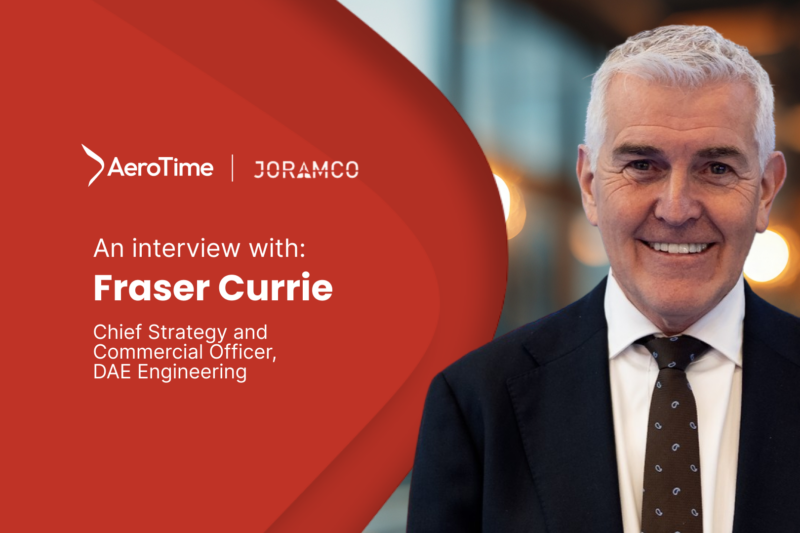
Speaking to AeroTime at MRO Europe in Amsterdam, held from October 27 to 29, 2026, Fraser Currie, Chief Strategy and Commercial Officer at DAE Engineering, outlined how the company intends to build on its growing international presence while keeping workforce development and safety at the heart of its strategy.
“Our growth strategy is based on what our customers are asking for,” Currie said. “We could have built three hangars at the same time, but would we have been able to control our expansion through the people? No, we would have lost something in that process.”
Currie was appointed Chief Strategy and Commercial Officer at DAE Engineering after serving as Chief Executive Officer of Joramco from October 2021 to September 2025. DAE Engineering is the engineering division of Dubai Aerospace Enterprise (DAE), under which Joramco operates.
Two more hangars in Joramco’s expansion plan
Hangar 7 at Queen Alia International Airport (AMM), inaugurated by his H.M King Abdullah II on September 8, 2025, can accommodate aircraft up to the size of the Airbus A380 and increased Joramco’s capacity from 17 to 25 maintenance lines, according to the company.
Currie said MRO capacity remains in short supply, with about 60% of Joramco’s business coming from Europe and the remaining 40% from the wider region.
Of the two planned hangars, one would add another five maintenance lines. However, Currie said the next facility built is likely to be a widebody paint hangar, as painting “becomes an essential part of that portfolio” at Joramco’s scale.
Safety, he stressed, remains the overriding consideration when deciding how quickly to expand.
“Your first priority is safety, and your last priority is safety,” he said, adding that safety is the first item discussed at board meetings and daily morning operations meetings.
Joramco Academy builds its own MRO workforce
Supporting that expansion is Joramco’s investment in its own workforce. Through Joramco Academy, the company is training the next generation of aircraft maintenance engineers, helping ensure that its growing hangar capacity is matched by a steady supply of skilled technicians.
“The academy is the first step into MRO,” Currie said.
Its four-year aircraft maintenance engineering program combines two years of academic training with two years of practical experience, preparing students for licensing under European Union Aviation Safety Agency (EASA) and Jordanian Civil Aviation Regulatory Commission (CARC) requirements. A five-year bachelor’s program developed with the University of Jordan, launched in 2025, provides an additional academic pathway.
Currie wants recruits to arrive already knowing “who Joramco is, what we are, what we expect.” Jordan, he said, “has an appetite for engineering” and provides a substantial pool of potential recruits.
The academy moved into a new 5,000-square-meter (approximately 54,000-square-foot) building in October 2024, but Currie said it is already being expanded again.
Rather than simply discussing the industry’s shortage of qualified technicians, he believes MRO providers need to take responsibility for developing their own workforce.
“Don’t talk about it. Get on and do it,” he said.
The combination of classroom instruction, practical experience and structured on-the-job training is also attracting international trainees.
About 15% of Joramco’s employees come from outside Jordan, a proportion Currie expects to maintain because the exchange of experience “keeps everyone sharp.”
“You learn off me, I learn off you,” he said.
Paperless maintenance brings new efficiency gains
In April 2026, Joramco announced that EASA had granted it full approval to operate without paper-based maintenance records. Developed in collaboration with software provider EmpowerMX, the system made Joramco, according to the company, the first paperless MRO in the Middle East and North Africa.
“To be a profitable MRO, you have to be efficient, and you have to be laser focused on what you do,” Currie said.
He acknowledged that change comes slowly in aviation, comparing the industry to an oil tanker that is difficult to turn, “and rightly so,” given its stringent safety requirements.
Nevertheless, Currie said the paperless system had already improved efficiency by approximately 7.5%. Joramco expects that gain to reach around 15% once employees have fully adapted to the new processes.
The system incorporates artificial intelligence (AI) and machine learning to reduce human-factor risks during maintenance sign-offs, particularly by preventing technicians from skipping required steps.
“The electronic sign-off will not let you go to the next stage until the first stage is finished,” Currie explained.
Digital tools are also changing how technicians inspect aircraft structures. According to Currie, electronic scanning of damage to fuselages and wings has reduced a process that previously required two or three people working for two or three days before the results reached engineering to approximately two minutes.
Yet he does not believe automation will remove technicians from aircraft maintenance.
He recalled being asked by an original equipment manufacturer to help design a hangar of the future that would require no people. His response was straightforward: “Design me an aircraft that doesn’t require maintenance.”
Currie acknowledged that Joramco is not pursuing digitalization as extensively as some other MRO providers. Instead, the company is concentrating on technologies it believes will deliver the greatest operational benefits.
“For us, the paperless is the big game changer,” he said.
Predictable maintenance and closer customer oversight
“We spend a lot of time talking about predictive aircraft maintenance now, and for us, it’s predictable aircraft maintenance,” Currie said.
For Joramco, that means delivering a 30-day maintenance check within 30 days, unless additional findings require more work.
The company has also invested in bringing airline representatives closer to the maintenance process.
In September 2026, Joramco opened a new Customer Center with 35 offices accommodating up to 108 airline representatives, according to the company. The facility provides direct access to the hangars, allowing customers to follow the work being carried out on their aircraft.
Each customer relationship is governed by an interface document setting out what Currie described as the “rules of engagement.”
Rather than “putting people into offices here, there and everywhere,” he said, the new facility creates “a central location and much more efficient” working environment.
Currie credits that focus on dependable delivery, alongside training, with helping Joramco gain greater recognition in the global MRO industry. But he said there is little time to dwell on achievements.
“We give ourselves a pat on the back. We then move on rather quickly and get on with the delivery.”
When DAE acquired an 80% stake in Joramco in September 2016, the company was “very much a regional small MRO,” Currie recalled.
“Now we’re playing in the premier division of global MROs,” he said.
Managing geopolitical risk in Jordan
Currie describes Jordan as “the Switzerland of the Middle East,” emphasizing the country’s position as a relatively stable base for aviation maintenance in the region.
Nevertheless, the 2026 conflict between the United States and Iran has affected Jordanian airspace, prompting EASA to issue a conflict zone information bulletin on July 22, 2026.
On October 14, 2026, EASA revised its guidance, replacing its recommendation against operating in Jordanian airspace with advice for operators to assess potential risks and maintain contingency plans.
The agency noted that no kinetic military activity affecting Jordanian airspace had been reported since September 9, 2026, although it warned that the security situation could deteriorate rapidly.
According to Currie, the easing of restrictions has encouraged customers to return, although some never stopped sending aircraft to Joramco.
He pointed to large flag carriers that continued working with the company “throughout the whole geopolitical tension.”
Joramco provides customers with risk assessments covering the safety of their personnel and aircraft while on the ground.
“You give your customers confidence, and that’s what we do,” Currie said.
Diversification is another important part of that approach. During the COVID-19 pandemic, Currie observed that smaller MRO providers dependent on a single aircraft type or a handful of customers were particularly vulnerable.
Joramco, by contrast, serves airlines from Europe, the Middle East, Latin America and Asia, spreading its exposure across markets with different approaches to managing risk.
“That’s what keeps us ahead of the game,” he said.
Among its customers is German leisure carrier Condor, which signed a five-year base maintenance agreement with Joramco in February 2026, with work scheduled to begin ahead of the winter season.
Beyond 2027: More hangars and a larger training role
Looking to 2027 and beyond, Currie identified the two additional hangars and the continued expansion of Joramco Academy as the company’s principal priorities.
“Without people, we have no business,” he said.
He also wants the academy to play a greater role in training technicians from other airlines, particularly smaller operators whose engineers may have fewer opportunities to work on different aircraft types.
“I’d like to work with more airlines in partnerships to bring people to Joramco and give them that expansion of knowledge,” Currie said.