

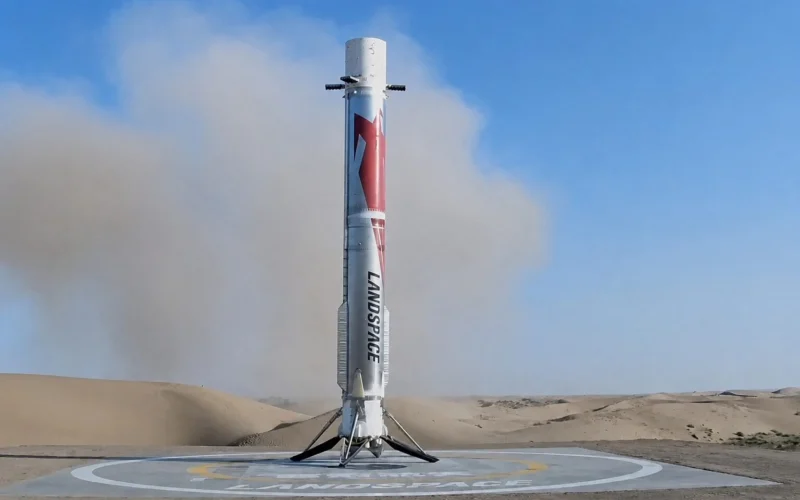
SpaceX could face formidable new competition in the space launch market in the wake of China’s LandSpace successfully landing the first stage of its Zhuque-3 rocket. In doing so, LandSpace has become the first private Chinese company to recover an orbital-class booster using the same method as SpaceX’s reusable Falcon 9 rocket.
The Zhuque-3 lifted off from the Dongfeng Commercial Space Innovation Pilot Zone in northwestern China at 07:35 local time on August 19, 2026.
After separating from its second stage, the booster reoriented itself, completed a reentry burn and descended toward a landing site in Minqin County in Gansu province, approximately 240 miles from the launch pad.
The booster deployed its landing legs and touched down vertically nearly eight minutes after liftoff.
“This mission marks China’s first-ever successful recovery attempt of the first stage of an orbital-class launch vehicle using landing legs, and China’s first successful booster recovery on land,” LandSpace declared in a statement.
Video released by the company shows a gentle touchdown reminiscent of the technique SpaceX pioneered a over a decade earlier with the first successful Falcon 9 landings.
The launch was the second flight of Zhuque-3, as well as LandSpace’s second attempt to recover its first stage. The rocket reached orbit on its inaugural flight in December 2025, but an abnormal combustion event prevented the booster from completing its landing.
According to LandSpace, it made several changes before the second flight, including revisions to the landing propulsion system, thermal protection and return-control software. The company also added a predicted-impact-point function to the rocket’s autonomous flight termination system.
Zhuque-3 uses nine methane-fueled engines on its first stage. Its stainless-steel construction and liquid methane and liquid oxygen propulsion system are intended to support repeated flights, while reducing manufacturing and refurbishment costs.
LandSpace says an expendable Zhuque-3 can carry as much as 14.2 metric tons to low Earth orbit. The company wants to fly each first stage as many as 20 times and plans to attempt the first reuse of a recovered booster within six months.
The successful landing places LandSpace alongside both SpaceX and Blue Origin as the only private companies to have propulsively landed the booster of an orbital-class rocket.
SpaceX first landed a Falcon 9 booster in December 2015 and has since made booster recovery and reuse a routine part of its launch operations. Blue Origin landed the first stage of its New Glenn orbital rocket for the first time in November 2025.
SpaceX founder Elon Musk had not publicly commented on the successful landing as of August 20. In an October 2025 post on X, however, Musk said the Zhuque-3’s combination of stainless-steel construction, methane propulsion and a Falcon 9-style architecture could enable it to eventually outperform Falcon 9.
China completed its first recovery of an orbital-class booster in July 2026 during the inaugural flight of the state-developed Long March 10B. Instead of landing on legs, that stage was captured by cables stretched across an offshore platform.
LandSpace, founded in 2015, had already claimed another first in commercial spaceflight, with its smaller Zhuque-2 becoming the first methane-fueled rocket to reach orbit in July 2023.
The company is seeking to raise 7.5 billion yuan, or approximately $1.1 billion, through an initial public offering in Shanghai. It plans to use the funding to expand development and production of reusable launch vehicles in its quest to compete in the commercial space launch market.