

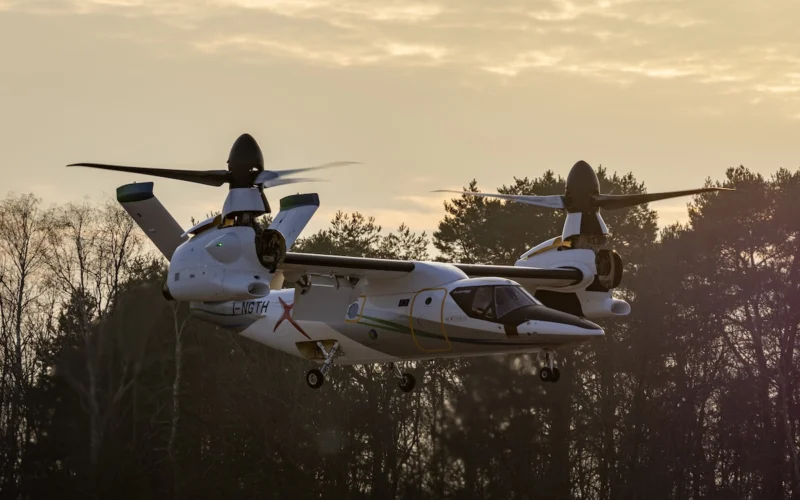
Leonardo announced that it has successfully completed the first flight of its Next Generation Civil Tiltrotor – Technology Demonstrator (NGCTR-TD), a project that it is conducting together with the Clean Aviation Joint Undertaking program of the European Union.
This maiden flight took place on December 19, 2025, at Leonardo’s facility in Cascina Costa di Samarate, near Milan Malpensa International Airport (MXP), Italy.
Launched in 2015, the Next Generation Civil Tiltrotor (NGCTR) program aims to develop a tiltrotor aircraft which combines the vertical takeoff and landing capabilities of a helicopter with the horizontal flight performance of a fixed-wing aircraft.
The technology demonstrator targets a cruise speed of 280 knots (520 km/h) and a range of approximately 1,000 nautical miles (1,850 km), opening up a number of potential uses in both the civilian and military spheres.
The program also focuses on delivering an environmentally efficient performance, which is a major reason it has been funded by Clean Sky 2, a core initiative of the European Horizon 2020 program. The NGCTR-TD also aims to develop critical aerospace capabilities in Europe, bringing together 85 industrial partners across the supply chain from 15 different countries.
Interestingly, Leonardo has long had its own tiltrotor program, the AW609. Development of this clean-sheet tiltrotor, which has been designed primarily with the civilian market in mind, started in the late 1990s, and a first prototype first flew in 2003. The development process, however, has been rather lengthy and not without challenges. As of December 2025, the AW609 has not yet completed its certification process.
The Next Generation Civil Tiltrotor (NGCTR) draws heavily from the learnings of the AW609 program, and it uses the same fuselage. However, the new tiltrotor model incorporates five new key technologies which contribute to a more efficient flight profile and reduce the aircraft’s environmental footprint.
A remarkable difference with the AW609 is the presence on the NGCTR of fixed engines. This compares to the AW609 in which engines and rotors tilted together. Instead, the NGCTR-TD uses a split-gearbox system which allows it to keep its engines fixed and move its propellers independently.
Around 20 patents have derived from work on the NGCTR.