

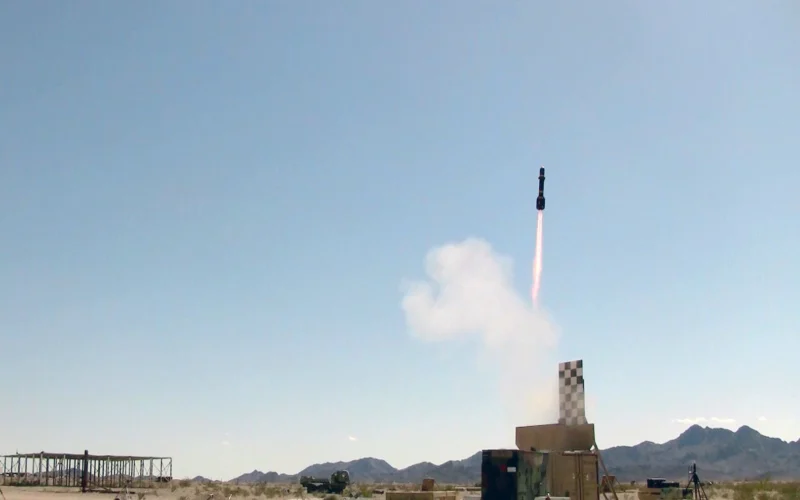
Lockheed Martin says it has intercepted a Group 3 one-way attack drone for the first time using a Joint Air-to-Ground Missile (JAGM) fired from its GRIZZLY containerized launcher, in a test it assembled and live-fired in under 45 days.
In the demonstration conducted at Yuma Proving Ground, Arizona, Fortem R-40 radars detected and tracked the target, the company’s Sanctum counter-UAS (C-UAS) battle manager processed the engagement, and the GRIZZLY launcher fired a JAGM that neutralized the drone.
A containerized kill chain
Lockheed Martin said the system, built on existing prototype architecture, can be mounted on ground sites or maritime platforms and fielded within days, operating standalone or linked into higher-echelon command and control through a mesh network. It builds on a run of recent GRIZZLY work: a first Hellfire vertical-launch test, and a JAGM Quad Launcher shot against a UAS target at China Lake.
It is pitching the architecture as a low-cost, modular point-defense solution against Group 1 to 4 UAV threats, citing an eight-round magazine, toolless reload, low-cost commercial sensors and minimal infrastructure.
“This test demonstrates a rapid, low-cost and modular point-defense solution that can be deployed on land or maritime platforms within days,” said Paul Lemmo, Vice President and General Manager of Lockheed Martin Sensors, Effectors and Mission Systems.
The US military’s classification runs from Group 1 micro-drones up to Group 5; the Group 1 to 4 band covered here spans small hand-launched quadcopters through to larger systems up to and beyond 1,300 pounds, including the Group 3 class of one-way attack drones now common on the battlefield.
The cost question
The “affordable lethality” framing will draw scrutiny: JAGM costs well into the six figures per round, far more than the one-way attack drones now straying into NATO airspace along the Baltic flank. Lockheed Martin’s modular, effector-agnostic approach echoes European efforts such as Sweden’s GUTE II package, and competes with cheaper options including purpose-built interceptor drones.