

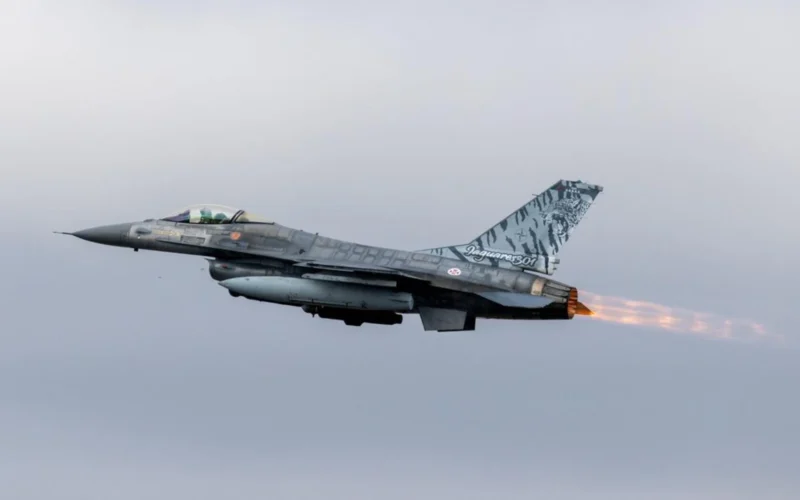
One of NATO’s Baltic Air Policing fighter jets shot down an intruding drone over Lake Võrtsjärv in southern Estonia on May 19, 2026, after the Estonian Defense Forces issued an air threat alert covering six counties.
Estonian Defense Minister Hanno Pevkur said debris fell on land near the village of Kablaküla, close to Põltsamaa, with no civilian damage reported.
“We received advance information from our Latvian colleagues, and our radar also detected a drone moving into southern Estonia,” Pevkur told public broadcaster ERR. “We activated the necessary measures, and a Baltic Air Policing fighter jet shot the drone down.”
As part of NATO’s Baltic Air Policing rotation, Portuguese Air Force F-16Ms are currently deployed at Ämari Air Base in Estonia, having taken over the rotation from an Italian Eurofighter detachment in late March 2026, while French Rafale and Romanian F-16 detachments operate from Šiauliai in Lithuania. Tallinn did not specify which type carried out the interception.
The alert was issued at 12:00 local time across Tartu, Jõgeva, Viljandi, Valga, Võru, and Põlva counties before being lifted at 12:55. Latvia simultaneously activated cell broadcast warnings in the municipalities of Preiļi, Rēzekne, Ludza, and Krāslava, according to the broadcaster LSM.
Romanian F-16 from Šiauliai confirmed as interceptor
Lithuania’s Ministry of Defense confirmed shortly after the interception that the NATO fighter that downed the drone was based at a Lithuanian air base.
Today, a NATO fighter jet stationed in Lithuania shot down a drone after it entered Estonian airspace. Following airspace violations in Estonia and Latvia, there are no confirmed incidents in Lithuania. All responsible institutions remain alert and ready to respond.
— Lithuanian MOD 🇱🇹 (@Lithuanian_MoD) May 19, 2026
AeroTime understands the shootdown was carried out by a Romanian Air Force F-16 from the “Carpathian Vipers” detachment, which has been operating from Šiauliai Air Base since April 1, 2026, alongside the French Rafale contingent leading Baltic Air Policing 71.
Probable Ukrainian drone diverted by Russian electronic warfare
Marko Mihkelson, chair of the Estonian Parliament’s Foreign Affairs Committee, said on social media that the intruder “was most likely a Ukrainian drone that had veered off course due to Russian electronic interference.”
The shootdown coincided with a renewed drone wave in Russia’s northwestern regions: the civil aviation authority, Rosaviatsiya, twice closed St. Petersburg’s Pulkovo Airport and Pskov Airport on the morning of May 19, citing flight safety.
Second Baltic incursion in 48 hours
The interception came less than 48 hours after a separate cross-border incident in Lithuania. On May 17, 2026, a resident in the village of Samanė in the northern Utena district discovered drone wreckage in a field while mowing his lawn. Lithuanian military radar had not detected the aircraft. Vilmantas Vitkauskas, head of the National Crisis Management Center, said the wreckage indicated a likely Ukrainian drone that had transited Latvian airspace before crashing in Lithuania.
Officers from Lithuania’s ARAS anti-terrorist operations unit later confirmed the presence of explosives at the crash site, and the drone was neutralized in a controlled detonation on May 18, 2026, after police determined transport posed too great a public risk. The Prosecutor General’s Office has merged the investigation with a pre-trial probe into Russian war crimes in Ukraine, and Prime Minister Inga Ruginienė is scheduled to convene the National Security Commission to review the case.
Both incidents extend a pattern of stray drones along NATO’s eastern flank coinciding with intensified Ukrainian long-range strikes on Russian oil export infrastructure on the Gulf of Finland.
Russian threats to the Baltic states intensify in parallel
The shootdown unfolded against the backdrop of an escalating Russian rhetorical campaign accusing the Baltic states of allowing Ukrainian drones to transit their airspace toward targets inside Russia.
Hours before the Estonian interception on May 19, 2026, Russia’s Foreign Intelligence Service (SVR) accused Latvia of agreeing to host Ukrainian drone units at five military bases. In a barely veiled threat, the agency said the locations of Latvia’s “decision-making centers are well-known” to Moscow and that NATO membership would not protect Riga from retribution.
❗️Russia lies again❗️This time it is SVR or the External Intelligence Service running a disinformation campaign against Latvia.
— Baiba Braže (@Braze_Baiba) May 19, 2026
✅FACT: Latvia does NOT provide airspace for attacks on Russia. That has been explained several times to Russian representatives. pic.twitter.com/0NqrwQGzIB
Tallinn, Riga and Vilnius issued a joint rejection on April 10, 2026, stating that they had never allowed their territories or airspace to be used for drone strikes against Russia. Lithuanian Seimas Speaker Juozas Olekas separately said Lithuanian authorities could not rule out that Russia might deliberately divert Ukrainian drones toward Lithuania, or simulate and launch its own drones designed to be mistaken for Ukrainian ones.