

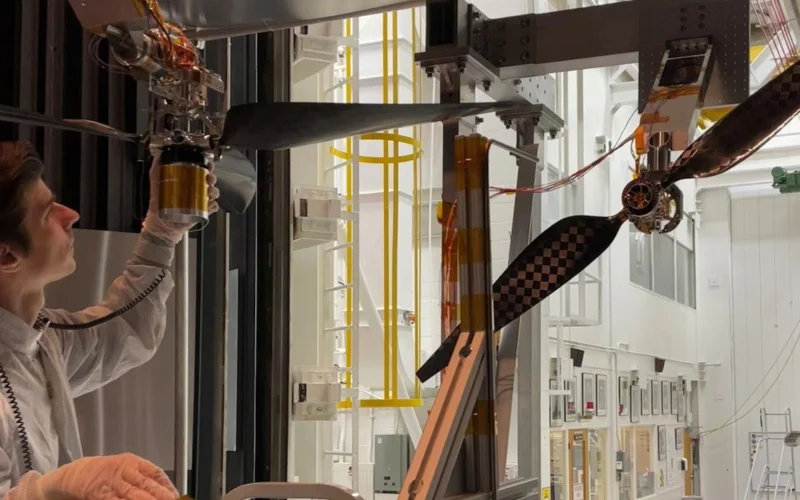
NASA has tested rotor blades for future Mars helicopters past the speed of sound, a milestone that could allow future aircraft on the Red Planet to carry heavier payloads and fly farther.
The tests took place recently at NASA’s Jet Propulsion Laboratory in Southern California, where engineers spun next-generation Mars helicopter rotor blades inside the 25-Foot Space Simulator, a chamber that can replicate the thin, carbon dioxide-rich atmosphere of Mars.
The team pushed rotor tip speeds to Mach 1.08 during 137 test runs. NASA said the tests boosted the Mars vehicle’s lift capability by 30%, a breakthrough that could support larger batteries, advanced sensors and heavier scientific instruments on future aircraft.
“The successful testing of these rotors was a major step toward proving the feasibility of flight in more demanding environments, which is key for next-gen vehicles,” said Shannah Withrow-Maser, an aerodynamicist from NASA’s Ames Research Center and member of the test team.
Because the atmosphere on Mars is only about 1% as dense as Earth’s, it is difficult for rotors to generate lift. To compensate, engineers need faster rotor speeds or larger blades. But as the blade tips accelerate, they move closer to the speed of sound.
On Earth at sea level, Mach 1 is about 760 mph. On Mars, the speed of sound is closer to 540 mph because of the planet’s cold, thin, carbon dioxide-rich atmosphere.
That means future Mars helicopters may need to operate close to the edge of supersonic for NASA to be able to carry out missions beyond the capaqbility of its current Ingenuity helicopter.
Supersonic blade tips would likely generate localized shock waves, though Mars’ extremely thin atmosphere means they would not produce the kind of loud sonic boom associated with supersonic aircraft on Earth.
For the tests, NASA engineers lined part of the simulator chamber with sheet metal in case the blades broke apart during the supersonic runs. The team first spun a three-bladed rotor as high as 3,750 rpm, then added headwinds inside the chamber to push the rotor tips past Mach 1.
NASA said the tests will help engineers design aircraft that can carry science instruments, sensors and other payloads for future robotic and human exploration missions.
The work builds on NASA’s Ingenuity Mars Helicopter, which made the first powered, controlled flight on another planet on April 19, 2021. Ingenuity was designed as a technology demonstrator and did not carry science instruments, but it ultimately completed 72 flights on Mars.
NASA’s next-generation aircraft would do more than prove flight is possible. The agency’s SkyFall project and other future Mars aircraft concepts aim to use low-altitude aerial exploration to collect data, scout terrain and support new missions.
The SkyFall team has already incorporated the rotor test findings into its performance specifications. NASA said SkyFall is designed to carry three next-generation Mars helicopters to the Red Planet in December 2028.
“We thought we’d be lucky to hit Mach 1.05, and we reached Mach 1.08 on our last runs,” Withrow-Maser said. “We’re still digging into the data, and there may be even more thrust on the table. These next-gen helicopters are going to be amazing.”