


NATO’s Support and Procurement Agency (NSPA) awarded the contract to replace the alliance’s aging fleet of Boeing E-3A Sentry airborne warning and control system (AWACS) aircraft to Sweden’s Saab and Canada’s Bombardier on April 21, 2026, according to French defense publication La Lettre.
The two companies would supply their GlobalEye airborne early warning and control (AEW&C) platform to replace all 14 aircraft currently operated by the alliance.
If confirmed, the award would end a years-long procurement process that saw Boeing’s E-7A Wedgetail eliminated from contention after the United States pulled back from the program, and would mark the first time in nearly four decades that a non-Boeing platform serves as NATO’s common airborne surveillance backbone.
Saab says no NATO GlobalEye contract has been signed
“It is up to NATO to comment on where they are in their procurement process,” Mattias Rådström, Head of Media Relations at Saab, told AeroTime in an emailed statement. “I can confirm that we have provided information to them but we have not signed a contract or received an order from NATO for GlobalEye.”
The end of the road for Wedgetail
NATO’s fleet of 14 Boeing E-3A Sentry aircraft, based at NATO Air Base Geilenkirchen in Germany, has been operational since 1982 and is expected to retire around 2035. Efforts to replace it have been underway since 2016 under what is now known as the Alliance Future Surveillance and Control (AFSC) program.
In November 2023, NATO selected the Boeing E-7A Wedgetail as its next-generation command-and-control aircraft, with six aircraft expected and the first planned to become operational by 2031.
That plan began to unravel in June 2025, when the US Air Force announced it would drop the E-7 from its fiscal 2026 spending plan in favor of space-based surveillance capabilities.
On November 13, 2025, the Dutch Ministry of Defense said the remaining partner countries had decided to abandon the acquisition of six Wedgetails, arguing that the earlier program had lost both its strategic and financial basis.
Dutch State Secretary for Defense Gijs Tuinman added that the US withdrawal also highlighted “the importance of investing as much as possible in European industry,” a position that may have strengthened the case for Saab’s GlobalEye as a more politically acceptable replacement.
By February 25, 2026, NATO allies had moved AFSC into its build-up phase, presenting the future replacement effort as a broader ‘system of systems’ rather than a simple one-for-one aircraft swap. Even so, a crewed AEW&C aircraft remained a key near-term requirement to cover the capability gap left by the aging E-3 fleet.
What GlobalEye brings
Saab first offered the GlobalEye for NATO’s AWACS replacement in February 2023. The platform is built around the Erieye Extended Range radar, capable of detection and identification over air, sea, and land at ranges exceeding 550 kilometers, mounted on a Bombardier Global 6000 business jet airframe.
Unlike the E-3A’s mechanically rotating rotodome, the Erieye uses an active electronically scanned array (AESA) radar in a fixed plank configuration atop the fuselage, providing faster target detection but requiring specific flight patterns to compensate for fore-and-aft coverage gaps.
Performance figures disclosed by Saab give the GlobalEye an endurance of more than 13 hours and a top speed of 450 knots. Saab has stated that the platform can operate from airfields with runways as short as 6,500 feet and has indicated a production capacity of up to three aircraft per year.
While Saab is the system integrator and the Erieye Extended Range radar is European, the aircraft is based on the Bombardier Global 6000/6500, which incorporates US-origin subsystems, including engines and avionics components subject to US export regulations.
At the Berlin Security Conference in November 2025, Saab CEO Micael Johansson said that SHAPE had concluded GlobalEye would fill the surveillance gap left by the retiring E-3 fleet if used in the right way, and that the platform could meet NATO’s operational target of 2031, or earlier.
A growing order book
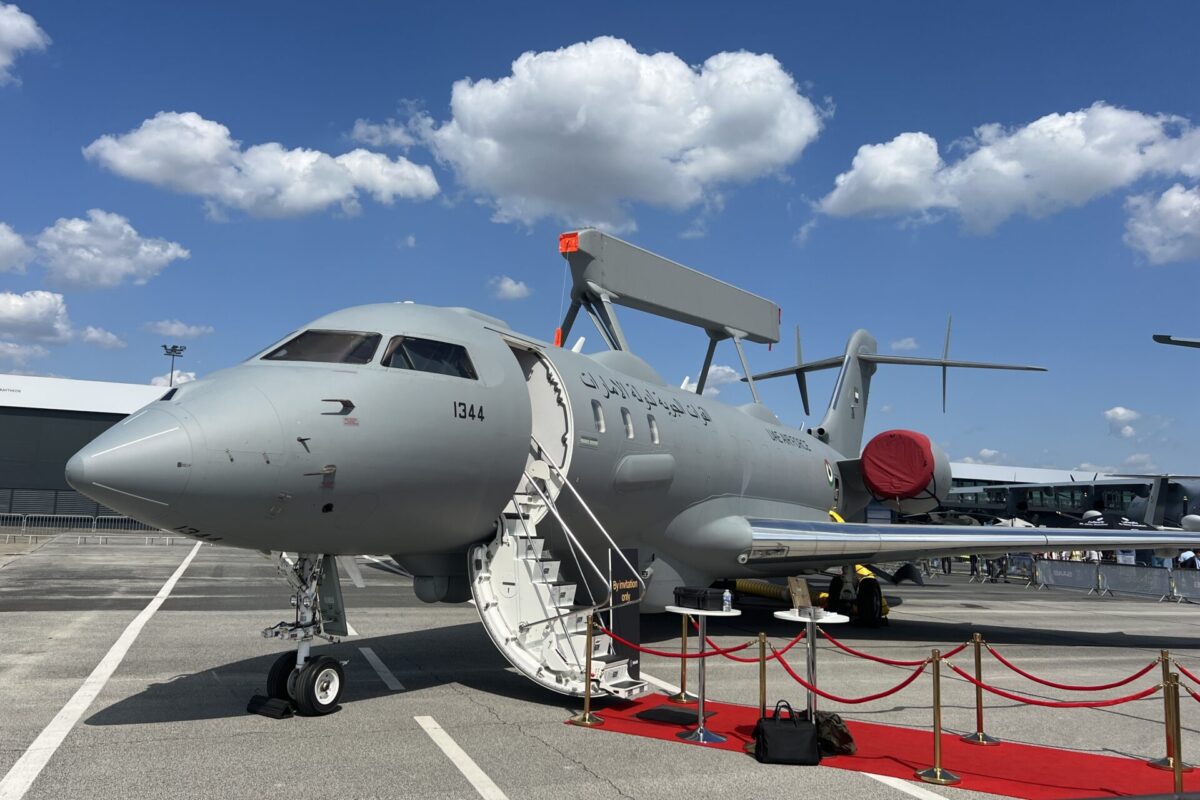
GlobalEye has already built a significant customer base, including in Europe, strengthening Saab’s position in the competition.
Sweden ordered two GlobalEyes in 2022 and later exercised an option for a third. The UAE operates five GlobalEyes and was the platform’s first export customer.
In December 2025, Saab signed a contract with the French General Directorate of Armaments (DGA) for two GlobalEye aircraft with options for two more with deliveries planned between 2029 and 2032. Johansson reported strong interest from Poland and Germany during the company’s first-quarter 2026 earnings webcast.
Canada is also eyeing as many as six GlobalEyes for its own air force alongside a potential Gripen acquisition over the F-35, a prospect that carries particular political weight given ongoing sovereignty tensions with the Trump administration. Saab has argued that combined Gripen and GlobalEye production in Canada could support more than 12,000 jobs, leveraging Bombardier’s existing Global business jet manufacturing base.