


Midnight alert followed by confirmed drone shootdown
In the early hours of September 15, 2026, Lithuania issued an air warning, two days after another alert was ultimately traced to a flock of birds.
A NATO fighter jet shot the drone down shortly after midnight near Pratkūnai village in Kaunas County, Lithuania’s National Crisis Management Centre said. The aircraft is believed to have entered from Belarus, although its origin has not yet been established.
The Lithuanian Ministry of Defense confirmed that Italian Air Force Typhoon fighters, deployed at Šiauliai Air Base as part of NATO’s Baltic Air Policing mission, shot down the drone.
“A drone that just entered Lithuanian airspace was destroyed by NATO fighter jets,” Lithuanian President Gitanas Nausėda said, thanking Allied personnel for their “swift response.”
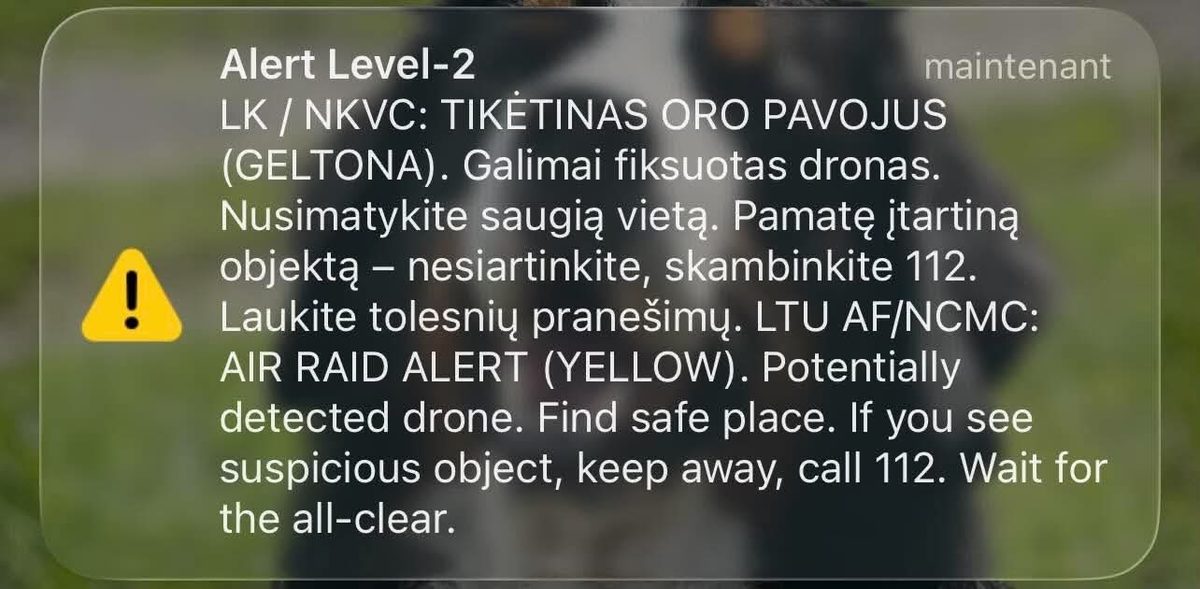
Residents had been warned of a possible air threat and advised to identify a safe location in case the alert was raised to red.
The drone’s type and the circumstances of the interception had not been disclosed at the time of writing.
Nausėda linked the incident to the wider security situation in the region, saying that Lithuania and its NATO allies would continue to defend the country’s airspace.
Suspected drone track traced to a flock of birds
NATO fighter jets launched from Šiauliai Air Base identified a flock of birds as the object behind a yellow air alert that suspended traffic at Vilnius Airport (VNO) for 38 minutes on September 13, 2026, Lithuania’s National Crisis Management Center (NKVC) said.
The alert covered Vilnius city and district, as well as the Trakai and Elektrėnai districts, and remained in force from 12:59 to 13:37 local time.
State airport operator Lietuvos oro uostai (LTOU) told news agency BNS that three flights were affected. Services arriving from Antalya and Amsterdam diverted to Kaunas Airport (KUN) before later continuing to Vilnius, while an aircraft that had departed Warsaw turned back.
According to the NKVC, radar returns from birds can initially resemble those produced by drones, prompting authorities to order an additional check.
NATO fighters were launched from Šiauliai to identify the contact visually. The Lithuanian Armed Forces said a confirmed drone would have led to a red-level warning, while the absence of a threat would allow the alert to be lifted.
The pilots identified the radar contact as a flock of birds, and the warning was subsequently canceled.
Unidentified object crossed Lithuania earlier that morning
The bird alert was separate from another incident recorded around nine hours earlier.
At 04:05 local time, Lithuanian Air Force radars near Varėna detected an unidentified object moving across Lithuanian airspace toward Russia’s Kaliningrad region.
The Lithuanian Armed Forces said the object traveled around 60 to 70 kilometers (37 to 43 miles) through Lithuanian airspace in approximately 20 minutes.
Available radar data was insufficient to identify it, but the military said there was no indication of an immediate threat. No public alert was issued and no fighters were scrambled.
NKVC head Vilmantas Vitkauskas told LRT radio that authorities considered the object most likely an unmanned aircraft, although the investigation remained open.
Possible explanations included a drone that had strayed from its intended route, a smuggling flight or hostile reconnaissance, he said.
Vitkauskas added that 22 smuggling drones had been recorded in Lithuanian airspace during September 2026 as of September 13.
The Lithuanian Armed Forces said the morning incident did not produce enough additional indications to justify an alert. By the afternoon, however, authorities were also monitoring activity from Belarus and reports of Russian and Ukrainian strikes, leading them to treat the later radar contact more cautiously.
Poland also scrambled over a flock of birds
Lithuania was not the first NATO country in the region to scramble aircraft over a radar contact that proved to be birds.
Poland’s Armed Forces Operational Command said on September 6 that indications near the Belarusian border had been caused by a large flock of birds rather than an airspace violation. Air navigation provider PANSA said operations at Rzeszów Airport were briefly suspended to accommodate military aviation activity.
On September 14, 2026, the Polish military recovered a drone from the Baltic Sea in the beach area at Rusinowo, near Jarosławiec. Defense Minister Władysław Kosiniak-Kamysz said a preliminary inspection indicated that it was a military unmanned aircraft of Russian origin.
Wygląda jak rosyjska Gerbera. Może ta która przeleciała przez Litwę, może inna.
— Jarosław Wolski (@wolski_jaros) September 14, 2026
Jak TVN24 podał oryginał zdjęcia i oznaczenia to wrzucę tutaj screena. Normalnie nie należy tego robić ponieważ bardzo to Rosjanom ułatwia identyfikację gdzie i co doleciało – stąd takie ładne i… https://t.co/Xsz7U1ABzs pic.twitter.com/J97wbP6Ii6
Images of the aircraft appear consistent with the Gerbera, a Russian decoy drone that has been linked to multiple airspace incursions across the region in recent months.
Baltic states seek stronger NATO air defenses
Lithuania has faced a series of airspace alerts and airport disruptions linked to objects that were initially difficult to identify.
Lithuania and Latvia issued simultaneous air danger alerts on May 20, 2026, after radar detected drone-like tracks near their borders.
The following day, the three Baltic presidents called on NATO to convert Baltic Air Policing into a full air defense mission, including counter-drone capabilities.
Vilnius Airport also experienced repeated closures during a wave of smuggling balloon incursions from Belarus in 2025.
The Italian Air Force took over NATO’s Baltic Air Policing mission at Šiauliai on July 31, 2026, deploying four Eurofighter Typhoons.