


France’s State aviation safety investigation bureau (BEA-É) has traced the August 2024 mid-air collision that killed two Rafale pilots to a “dual input” in the cockpit, where a trainee and his instructor commanded opposite control movements that the jet’s flight computers canceled out during an emergency avoidance.
How the collision unfolded
The BEA-É published its report on June 10, 2026, almost two years after the accident. On August 14, 2024, a pair of two-seat Rafale B jets from the Rafale Transition Squadron (ETR) 3/4 “Aquitaine,” based at Saint-Dizier, collided near Colombey-les-Belles in eastern France, about three nautical miles (five kilometers) from Nancy-Ochey air base.
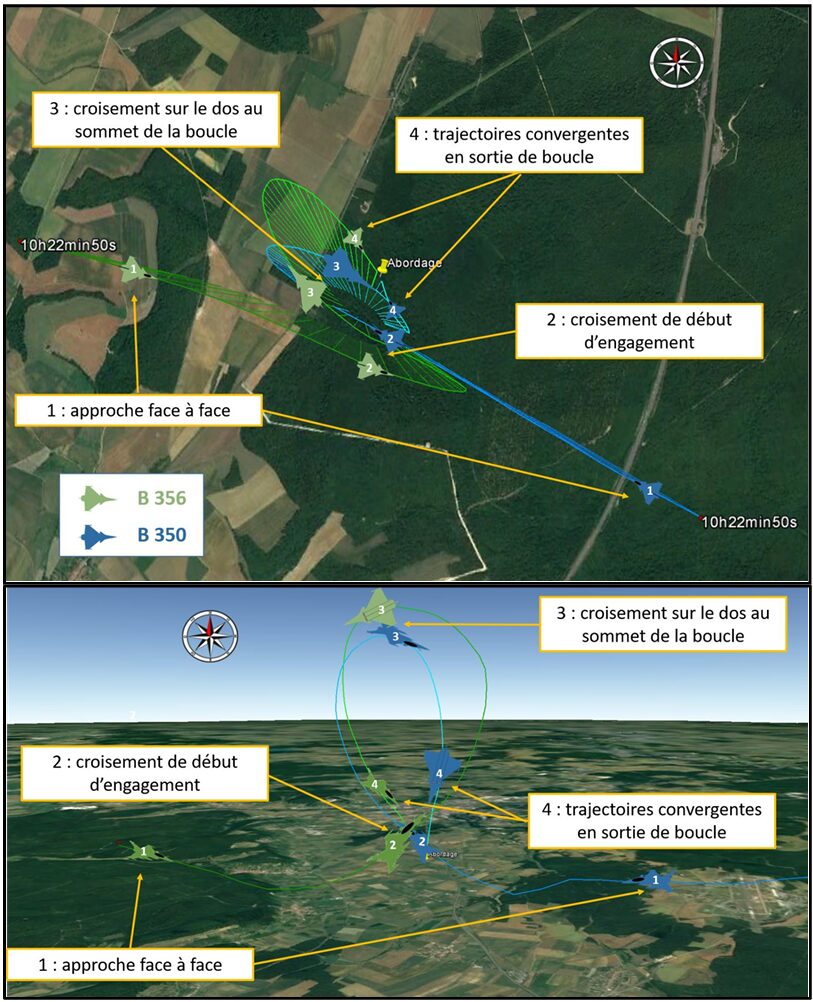
One jet carried a 29-year-old trainee and his 36-year-old instructor, who led the patrol; the second was flown solo by a 46-year-old wingman. After a refueling exercise over Germany was cut short by weather, the pair returned to the Nancy areas, ran simulated gun passes, and began an unplanned close-in air combat exercise, or Basic Fighter Maneuvers.
The two Rafale jets crossed head-on and pulled into a vertical loop. After passing inverted at the top, their descending paths converged. Both crews attempted an emergency avoidance, but the jets struck belly-to-belly at about 10,000 feet. The instructor and trainee died without ejecting; the wingman ejected after the collision and survived with minor injuries. Both aircraft were destroyed.
A command that canceled itself out
Investigators found no aircraft fault, with engines and flight controls working normally throughout. They focused instead on how the Rafale B’s two sets of controls behave when both seats act at once.
In the final seconds, as the jets converged, the trainee in front commanded full right roll and the instructor in the rear full left roll. Because the instructor did not press the priority trigger that overrides the front seat, the flight computers summed the two into a near-zero roll command. The leader’s flight path was uncontrolled for about 1.2 seconds, and the instructor’s recovery was delayed by 2.1 seconds. No handover was called, and at low speed and high angle of attack both jets were less responsive and their relative paths hard to judge.
Both more experienced pilots, the instructor and the wingman, read the situation the same way, and, unlike the trainee, initially broke left.
The report offers two possible explanations for the student pilot’s rightward choice: he may have applied the standard convention of breaking right in a head-on presentation, or his time-to-collision instincts, built during two years as a PC-21 instructor on a much slower aircraft, were simply poorly calibrated for Rafale speeds.
More common than crews realized
The report’s most striking finding concerns frequency: when the BEA-É reviewed 15 routine training flights at the squadron, 12 contained dual input. It concluded that crews held a false sense of mastery of the phenomenon, underestimating both the risk and the cockpit summation warning light, whose design made it hard to notice during visual combat. Instructor training barely covered the issue, and the French Air and Space Force keeps no fleet-wide record of dual input on the Rafale B.
The bureau also found that the trainee, after two years as a PC-21 instructor, had built “time to collision” references suited to that slower aircraft rather than the Rafale, possibly shaping his trajectory choices.
Six recommendations
The BEA-É issued six recommendations. Three go to the DGA, France’s defense procurement agency: redesign the hard-to-see control-summation indication, add a data marker so dual input can be tracked fleet-wide, and study fitting Rafale jets with a new audio-capable flight recorder, after data recovery was hampered by video recorders that are not crash- or fire-resistant.
Three go to the French Air and Space Force: adopt a dual input risk-management policy, strengthen “time to collision” training for pilots converting from other types, and, with the French Navy, refine anti-collision rules for visual combat, where the prescribed 1,000-foot (300-meter) separation cannot be precisely measured.
The two destroyed jets are among the aircraft France is replacing, with its 2026 defense budget funding two replacement Rafale fighters.
1 comment
Of course; if the sticks moved together, the accident would not have happened.
There have been numerous incidents with Airbus transport aircraft where dual inputs created problems.
A very hard landing on a 340 is one; resulted in a grounded aircraft and mandatory landing gear replacement.
Sticks that don’t move together are a very bad and now fatal problem.
Time to correct this bad engineering!
(Yes, it can be done!; see current Gulfstraam jets.)