

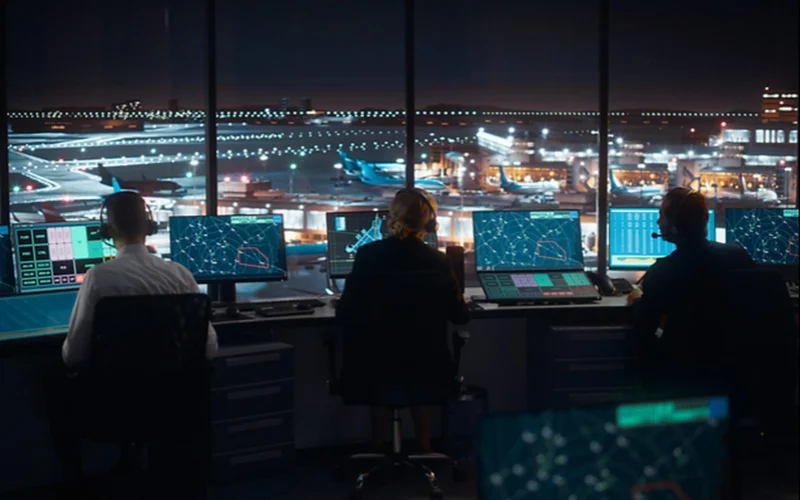
The Federal Aviation Administration (FAA) has deployed new technology at Ronald Reagan Washington National Airport (DCA) that replaces the paper flight strips that have long served as the backbone of flight operations across the United States with new digital tools developed by Leidos.
The system, created for the FAA’s Terminal Flight Data Manager (TFDM) program, introduces digital flight strips and a shared surface display intended to give controllers a real-time view of what’s happening on the ground. Leidos says the platform also provides real-time data and predictive modeling tools aimed at helping optimize aircraft movements, reduce delays, improve coordination, and strengthen safety at one of the US’s busiest airports.
According to Leidos, the FAA began implementing TFDM at Reagan National in June 2025, and said the deployment reached operational status 45% faster than the traditional 18-month rollout cycle. The company framed that accelerated timeline as a key milestone for a program the FAA plans to expand across additional airports.
“The FAA operates the most complex airspace in the world,” Roy Stevens, Leidos’ Homeland Sector President, said in the announcement. He said accelerating TFDM at Reagan National and other airports will help reduce controller workload, streamline operations, and enhance safety, while making air travel more efficient and predictable.
The big change for controllers is straightforward as antiquated paper strips go away and the new digital strips take their place. For decades, those narrow paper strips have been the tower’s living record of a flight as it moves through the airport surface and air environment. Controllers mark clearances, runway assignments, sequencing changes, and other updates by hand, and they physically move strips to reflect what’s happening in real time. It’s a system that works, but it can also be cumbersome.
Leidos says the digital strips, paired with an integrated surface display, provide a shared, real-time picture of airport activity for controllers, air traffic managers, and airline and airport operations teams. That common view, the company says, helps reduce risk, increase predictability, and smooth the flow of departures and arrivals.
Reagan National becomes the latest airport to bring TFDM online. Leidos said 10 airports currently use the system, with additional deployments planned in the months ahead.
US Transportation Secretary Sean Duffy leaned into the optics this week in a video, holding up the old paper strips and poking fun at how analog the job can look from the outside, before pointing to the new electronic setup as the kind of upgrade travelers assume already exists. The contrast depicted in the video probably surprised many viewers who learned for the first time that one of the most complex, safety-critical operations in aviation has relied on printed paper strips for such a long time.
Now, at least at Reagan National, those strips move from a clipboard to a computer screen, part of a broader push to bring improved technology tools to US airspace.
2 comments
It’s incredible how technology has transformed from analog flight paper strips to digital ones. These digital strips help reduce the controller’s workload and streamline operations, leading to fewer delays, improved safety, and more efficient, predictable air travel. For redundancy, it would be ideal to use both analog and digital tools, just like all other aviation systems.
What they need to do is get ALL aircraft flying in the DC metro area n the same channel, and under the same controllers. Obviously, multiple different controllers just doesn’t work.