

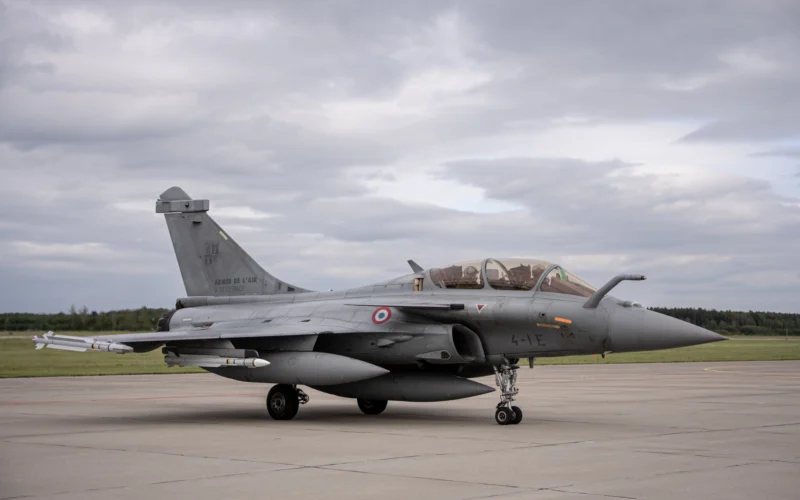
Russia will add European countries hosting French nuclear-capable Rafale to its list of priority targets in a major conflict, Deputy Foreign Minister Alexander Grushko said on April 23, 2026, in the sharpest Kremlin response yet to Emmanuel Macron’s “forward deterrence” doctrine.
Grushko made the comments in an interview with Russian state media, three days after Macron and Polish Prime Minister Donald Tusk announced in Gdansk on April 20, 2026, that Warsaw would join the group of European capitals discussing joint exercises and possible future deployments of French nuclear-capable Rafale fighter jets.
A response to Gdansk
In Gdansk, the French and Polish leaders said the agenda between Paris and Warsaw would include information exchange and joint military exercises covering elements of forward deterrence, a posture Macron introduced in his March 2, 2026 speech at Île Longue. Macron added that work in the coming months would aim at “concrete progress,” notably on the nuclear track.
Tusk told reporters that seeing Rafale carrying nuclear weapons over Poland was “not my dream,” but rather a reflection of the current strategic environment. He added that Poland was joining what he described as a circle of states that understand the need for European sovereignty in defense.
What is France’s forward deterrence?

As per Macron’s concept, forward deterrence relies on the temporary deployment of the Strategic Air Forces (FAS) and their nuclear-capable Rafale B to allied bases across the continent, without permanent basing or nuclear sharing arrangements modeled on NATO’s existing mechanism with the US Air Force.
The French Air and Space Force has spent the last several years validating this model under the MORANE concept, now known as French Agile Combat Employment (FRA-ACE), with short-notice deployments to Poland, Romania, and Sweden, using small detachments of 30 to 80 personnel. Extending that agility to the strategic air component, however, imposes stricter requirements on security, protected communications, and host-nation procedures when the aircraft are associated with the ASMPA-R nuclear cruise missile.
Warsaw’s inclusion builds on the list set out by Macron at Île Longue, which already covered the United Kingdom, Germany, the Netherlands, Belgium, Greece, Sweden, and Denmark. Paris is actively discussing hosting arrangements with those eight partners.
Denmark has already concluded a strategic nuclear deterrence agreement with France, intended to complement NATO’s existing arrangements. The day after the Île Longue speech, Norway’s foreign minister declared that Oslo was also ready to discuss joining. Sweden and Finland have already made clear they will not host nuclear weapons in peacetime, which limits the posture to exercises and crisis-period dispersal rather than a standing presence.
Lithuanian President Gitanas Nausėda and his Latvian counterpart, Edgars Rinkēvičs, publicly engaged with the proposal following a phone call, with Nausėda welcoming any allied step that complicates Russia’s nuclear calculations in Europe. However, he stressed that France’s initiative should complement, not replace, NATO’s existing nuclear arrangements.
Šodien Lielvārdē viesojas divi Francijas iznīcinātāji “Rafale” ✈️
— NBS (@Latvijas_armija) April 14, 2026
Ikdienā šie lidaparāti atrodas Šauļos un rūpējas par visas Baltijas gaisa telpas drošību. Šī vizīte ir lielisks atgādinājums par NATO sabiedroto atbalstu un mūsu kopīgo aizsardzību 💪🏻#StrongerTogether #WeAreNATO pic.twitter.com/JfFcOmKRFa
On April 14, 2026, two French Rafale B from the ongoing Baltic Air Policing rotation at Šiauliai, Lithuania, flew to Lielvārde Air Base, in neighboring Latvia. The jets belong to the 4th Fighter Wing at BA 113 Saint-Dizier, home of France’s Strategic Air Forces (FAS) and the operator of the nuclear-capable Rafale variant. They were met by a senior delegation that included Prime Minister Evika Siliņa, Defense Minister Andris Sprūds, Foreign Minister Baiba Braže, and Chief of Defense Major General Kaspars Pudāns.

Moscow’s targeting message
Grushko framed France’s plans as part of an “uncontrolled build-up” of NATO’s nuclear potential, arguing that French nuclear forces now function as an integral component of the alliance.
“Our military will pay close attention to these new deployments and update the list of high-priority targets for potential major conflicts accordingly,” he said, according to a statement distributed by Russian state media.
He also dismissed the protection offered to potential hosts, noting that France has explicitly rejected formal nuclear guarantees for allies. Grushko claimed that the posture weakens rather than strengthens the security of the countries involved, because Paris offers no “ironclad guarantees” in exchange for their exposure.
Previously, Moscow had criticized the Île Longue speech and the UK-France Northwood Declaration of July 2025. Earlier Russian statements had concentrated on France’s decision to stop publishing its total warhead count, a move Moscow described as counter to practices inherited from the Nuclear Non-Proliferation Treaty era. This new intervention is the first time a senior Russian official has explicitly tied participation in France’s “forward deterrence” to Russian targeting plans.
Arms control vacuum
The exchange comes within a degraded environment for arms control. The New START Treaty, which capped deployed US and Russian strategic warheads, expired on February 5, 2026, removing the last bilateral cap on the two largest arsenals. Grushko said that any future nuclear dialogue would need to account for NATO’s combined capabilities, including the French and British deterrents alongside the US strategic forces.
Both statements land days before the opening of the eleventh Review Conference of the Parties to the Treaty on the Non-Proliferation of Nuclear Weapons, which runs from April 27 to May 22, 2026, at United Nations headquarters in New York. Held every five years, the review process is the main multilateral forum for assessing progress on non-proliferation, disarmament, and the peaceful uses of nuclear energy.
NATO used the run-up to the conference to call on Russia and China to commit to greater transparency on their own arsenals, while Grushko framed the French and British build-ups as a direct breach of treaty obligations by two of the five recognized nuclear weapon states.