

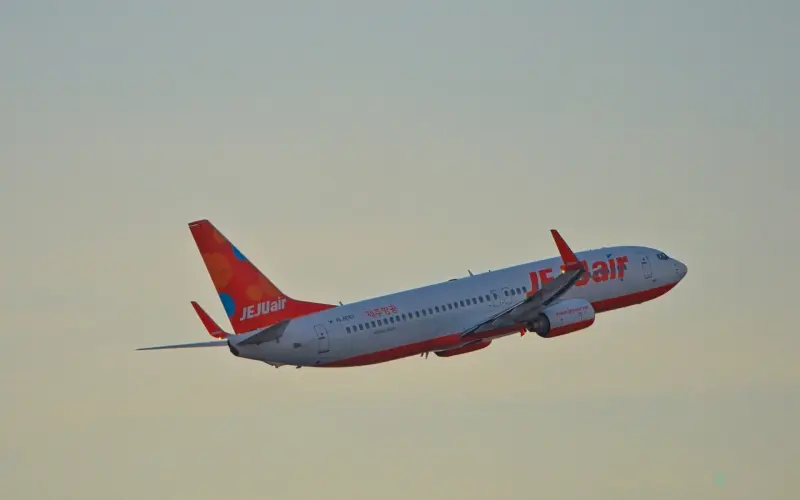
South Korean authorities have discovered bird feathers and blood in both engines of the Jeju Air aircraft that crashed and killed 179 people on December 29, 2024.
On January 16, 2025, Korean investigators announced that feathers were found in one of the engines recovered from the crash scene, as reported by local news outlet MBN. The Korea Aviation Accident Investigation Board confirmed that feathers were also found in the other engine.
The South Korean National Biological Resources Agency (NBRA), responsible for the analysis, indicated that “feathers came out of both engines”, and noted that “a total of 17 samples, including feathers and blood stains, have been analyzed”.
Investigators are examining several factors, including a bird strike, faulty landing gear, and problems with the runway barrier. The South Korea’s Ministry of Land, Infrastructure and Transport (MOLIT) declared that, based on the current evidence, bird collisions are likely the cause of the crash.
“We have confirmed that a bird strike occurred,” Lee Seung-yeol, Head of the Air and Rail Accident Investigation Commission (ARAIC), told a local news outlet NToday on January 8, 2025. “We found some feathers in the process of digging out the soil that entered the engine. We plan to investigate what species of bird it is and how it got in, by examining the inside of the engine.”
The flight data recorder (FDR) and cockpit voice recorder (CVR) from the Jeju Air crash only captured data up until around four minutes before the aircraft collided with an airport embankment. Reportedly the black box recordings stopped working at 08:59, with the crash occurring at 09:03.
On December 29, 2024, Jeju Air Flight 2216 from Bangkok made an emergency landing at Muan International Airport (MWX) without its landing gear extended, resulting in a high-speed touchdown.
The aircraft struck a concrete mound housing the localizer landing aid antenna at the end of the runway and became engulfed in a post-impact fire. The accident killed 179 of the 181 lives onboard, with only two flight attendants surviving.
Following the initial findings of the investigation, the Ministry of Land, Infrastructure and Transport (MOLIT) has reviewed landing aid installation structures at airports across the country. They found that seven of the 14 South Korean airports examined so far have concrete structures like those involved in the Jeju Air crash.
“We are initiating a special safety inspection of major airport facilities from January 13 to January 21, 2025,” said the Ministry statement. “Based on the findings, comprehensive safety measures will be developed, with localizer facility improvements targeted for completion by year-end [2025].”
3 comments
Well, that explains the need for an emergency landing, and the difficulty in slowing the plane before hitting that berm. Without reverse thrust to help slow the plane during the landing as well as on the ground, all they had was friction and brakes; not nearly enough…
Not even brakes….the landing gear was still up when she touched down.
Still no brakes as undercarriage retracted. A runoff area containing only frangible ILS structures is a must. If there is no space, then an arrester barrier and/or a shallow lake could be constructed to absorb the energy. LHR used to have the ‘cabbage patch’ which did a lot of damage to the aircraft but saved lives.