

AeroTime is excited to welcome Renato Oliveira as a guest columnist. Renato is Operations Director at PVJets Global Private Jets Company, which specializes in charter flights and helicopter transfers for entrepreneurs, individuals, families, and groups.
Renato spent 15 years as Senior Cabin Crew in the Middle East and has a lifelong passion for aviation history. He has also led the largest research project on Alberto Santos-Dumont and was condecorated by the Brazilian Air Force for efforts in aviation preservation.
Renato is now working to shape the future of private aviation, connecting today’s innovators with tomorrow’s history.
The views and opinions expressed in this column are solely those of the author and do not necessarily reflect the official policy or position of AeroTime.
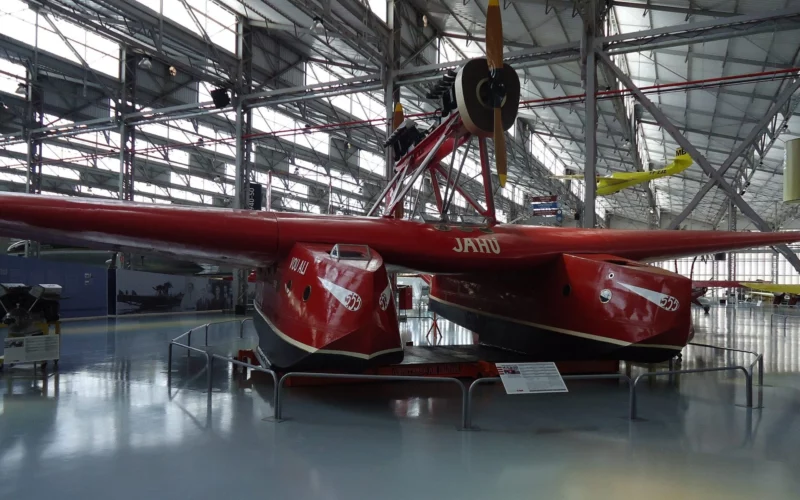
Between the two world wars, aviation soared from fragile experiment to global spectacle. Countries vied for the skies, turning airplanes into emblems of pride, ambition, and technological mastery. Among the boldest aircraft of that era was the Savoia-Marchetti S.55, an otherworldly flying boat that looked like something from a dream and flew like something from the future.
Conceived by the brilliant Italian designer Alessandro Marchetti, the S.55 first took flight in 1924. With its twin hulls, cockpit embedded in the wing, and push-pull engine configuration perched overhead, the aircraft broke every rule of conventional design and thrived because of it. Its stability and long-range capability made it ideal for crossing oceans. And in 1933, it dazzled the world when Italian Air Minister Italo Balbo led a fleet of 24 S.55s in tight formation across the Atlantic to the Chicago World’s Fair. The sight was so spectacular that “a Balbo” became slang for any massive air formation.
But six years before that, and nearly a month before Charles Lindbergh made his legendary solo flight from New York to Paris, a single S.55, patched together from the remnants of a wreck, made a quieter, braver, and far more perilous crossing.
Its name was Jahú.
The dream of João Ribeiro de Barros
João Ribeiro de Barros was not born to fly. He came from a wealthy Brazilian family in the town of Jaú (then spelled “Jahú”) and was expected to pursue a career in law. But after watching the 1922 Lisbon–Rio de Janeiro crossing by Portuguese aviators Gago Coutinho and Sacadura Cabral, Barros felt a pull he couldn’t resist. If they could fly from Europe to South America, why couldn’t a Brazilian return the honor?
He left everything behind, moved to Europe to study aviation, and began planning his dream: a solo-funded transatlantic flight, reversing the Portuguese route, with no foreign sponsorship, no diplomatic backing, and no safety net.
In 1926, Barros and his mechanic Vasco Cinquini traveled to northern Italy to acquire an S.55. But the factory refused to sell him a new one. His ambition, they feared, would end in disaster, and tarnish the aircraft’s reputation. Instead, they offered him a broken relic, the Alcione, an S.55 that had crashed in Casablanca during a failed Italian mission. It had spent months submerged in saltwater. Barros bought it anyway, for 680,000 lire – a fortune.
The plane was cosmetically restored, but during its first test flight on Lake Maggiore, it nearly sank. The hulls were rotted through. Barros demanded they be replaced with military-grade pontoons. He renamed the aircraft Jahú, in honor of his hometown, and painted two cheeky phrases on the pontoons: “Vou ali” (“Just going over there”) and “Já volto” (“Be right back”).
It was a promise – and a dare.
Sabotage, storms, and a brush with death
From the moment they launched in October 1926, trouble shadowed them. A faulty engine forced an emergency landing in Spain, where the crew was arrested on suspicion of smuggling. In Gibraltar, sabotage was discovered – soap, dirt, and water had been mixed into the fuel. In Cape Verde, someone had hidden a bronze chunk in the oil system, which could have destroyed the engine midair.
Then malaria struck Barros. His co-pilot was dismissed for insubordination. The plane was damaged trying to haul it ashore. The dream teetered on the brink. Barros nearly gave up – until a telegram from his mother gave him the strength to carry on.
In early 1927, a new co-pilot joined: João Negrão, a lieutenant in São Paulo’s Public Force. The crew was reborn.
Into the Deep Atlantic
At 04:30 on April 28, 1927, Jahú took off from Porto Praia, Cape Verde. Ahead lay 2,400 kilometers of empty ocean. No radio. No rescue plan. Just skill, nerve, and trust in the machine they had rebuilt with their own hands.
12 hours later, they spotted Brazil. The aircraft landed near Fernando de Noronha, with one propeller damaged but the crew intact. The Italian ship Angelo Toso rescued them and towed the aircraft ashore. A replacement propeller arrived from Recife, and on May 14, Jahú flew again.
In Recife, thousands filled the sky with fireworks to welcome them. The crowds cheered. Parades followed. For the final stretch to São Paulo, the crew added Antônio Machado Mendonça, a navy mechanic, uniting army, navy, police, and civilian in a single aircraft. A symbol of national unity.
Forgotten no more
The Jahú remains the only surviving Savoia-Marchetti S.55 in the world. Painstakingly restored, it is soon to become a star exhibit at MAPA, Brazil’s forthcoming National Aviation Museum in São Paulo.
While history lionizes Lindbergh, the Jahú and its crew accomplished a feat no less daring – crossing the Atlantic with no government behind them, no cheering crowds awaiting them on foreign soil, and no margin for error. It was a mission driven by pride, passion, and principle.
A forgotten flight. A salvaged aircraft. A dream that defied every expectation.
Before Lindbergh, there was Jahú.
4 comments
So there was Jahu, then L’Oiseau Blanc (if you crash land it doesn’t count, darn), and only then Lindberg.
Lindberg did it 22 days later. If does not has had all the issues, it will be much longer away. The speed record of 190km/h remained for 10 years.
What did João Ribeiro de Barros do after his trans Atlantic flight? Charles Lindbergh and his wife Ann followed up to his solo flight with numerous flights of a exploratory nature. Then when the US entered WW2 he taught USN pilots how to fly by managing RPM, leaning, and other skills to extend the range of their over water flights. There is no question that the crewed aircraft flown by João Ribeiro de Barros was a significant feat of courage. None. However, a solo flight of significant duration takes on great significance since a crew of ONE had no backups, no opportunities for rest, total responsibility for navigation, avigation, and all other tasks… any one of which was mission critical. Please do not denigrate Lindbergh’s amazing feat. He stood above the previous efforts because he did it solo. Alone. No back up, no rest.
Dear John T
Wonderful to have your message.
Lindberghs journey is a remarkable.
That needs to be honored for generations to come.
The purpose of my story is to highlight unsung heroes
From a nation at that time with minimal capability to support a journey like that. And heroic personalities that sacrificed their lives to face that dangerous mission.
I truly value Charles Legacy.
But erasing the predecessors from history is a typical event in the 20th century.
And most of all, that only S55 of the world, that did this beautiful crossing. Still alive and well in the new museum to come.
Will wait for your visit!