

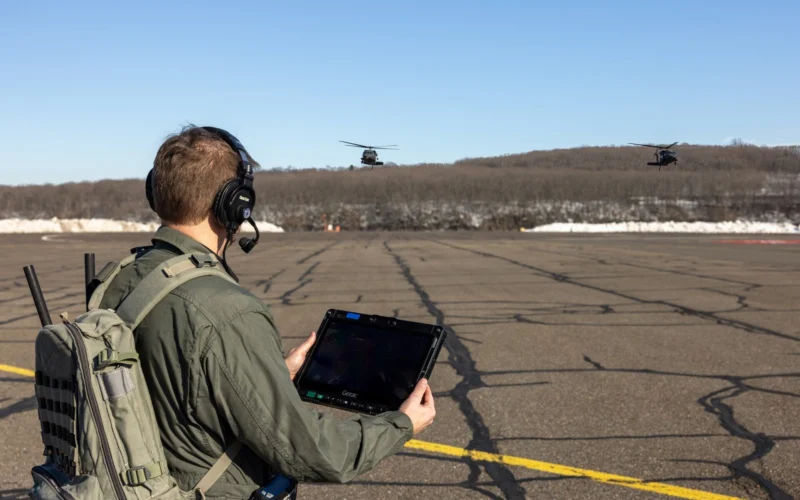
Sikorsky has delivered to the US Army an experimental UH-60MX Black Hawk helicopter equipped with its MATRIX autonomy suite, as the service advances work on optionally piloted and autonomous rotorcraft.
The Lockheed Martin subsidiary announced on March 23, 2026, that it had completed the integration and flight testing of the aircraft before handing it over to the Army for further evaluation.
The UH-60MX is a full-authority fly-by-wire, optionally piloted UH-60. The helicopter will now be used by the US Army Combat Capabilities Development Command, DEVCOM, as a testbed to assess autonomy concepts and human-machine teaming.
The aircraft is designed to help the Army explore how future helicopters could operate with reduced crew requirements or transition between piloted, optionally piloted, and fully autonomous modes.
MATRIX suite enters evaluation phase

Sikorsky said the MATRIX autonomy suite is intended to reduce pilot workload and support functions including obstacle avoidance, terrain awareness, landing zone identification, and flight in degraded visual environments.
The UH-60MX program builds on work funded by DARPA under its Aircrew Labor In-Cockpit Automation System, or ALIAS, program. In late 2024, Sikorsky received funding to install the autonomy package on the Army-owned experimental Black Hawk, with the goal of moving the platform closer to operational testing.
Black Hawk modernization effort gathers pace

The company has been developing MATRIX across several aircraft. At the Paris Air Show in 2025, Sikorsky said it had already demonstrated autonomous flight on a modified UH-60A Black Hawk and was positioning the technology as a way to support future missions ranging from logistics to combat support. Later that year, it also unveiled the uncrewed S-70UAS U-Hawk cargo drone, another Black Hawk-derived platform built around the same autonomy architecture.
The latest delivery also fits into the US Army’s wider effort to modernize the Black Hawk fleet. In 2025, Sikorsky received a separate Blackhawk contract to work on digital architecture upgrades and preparations for the future integration of launched effects and other uncrewed capabilities.