

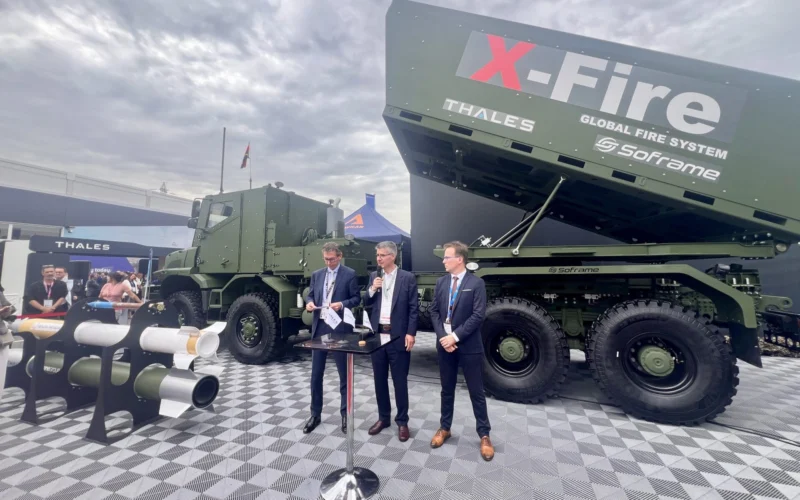
Soframe, Thales and ArianeGroup used the second day of Eurosatory on June 16, 2026, to present their X-Fire launcher and B-Strike munition family as a sovereign French deep-strike architecture spanning rocket artillery to long-range ballistic missiles.
The briefing at the Soframe stand near Paris came a day after France opened exclusive negotiations with a competing Safran-MBDA grouping to supply the Thundart rocket as the successor to the Lance-Roquettes Unitaires (LRU), the contest in which the X-Fire launcher had competed.
Modular launcher across several range classes
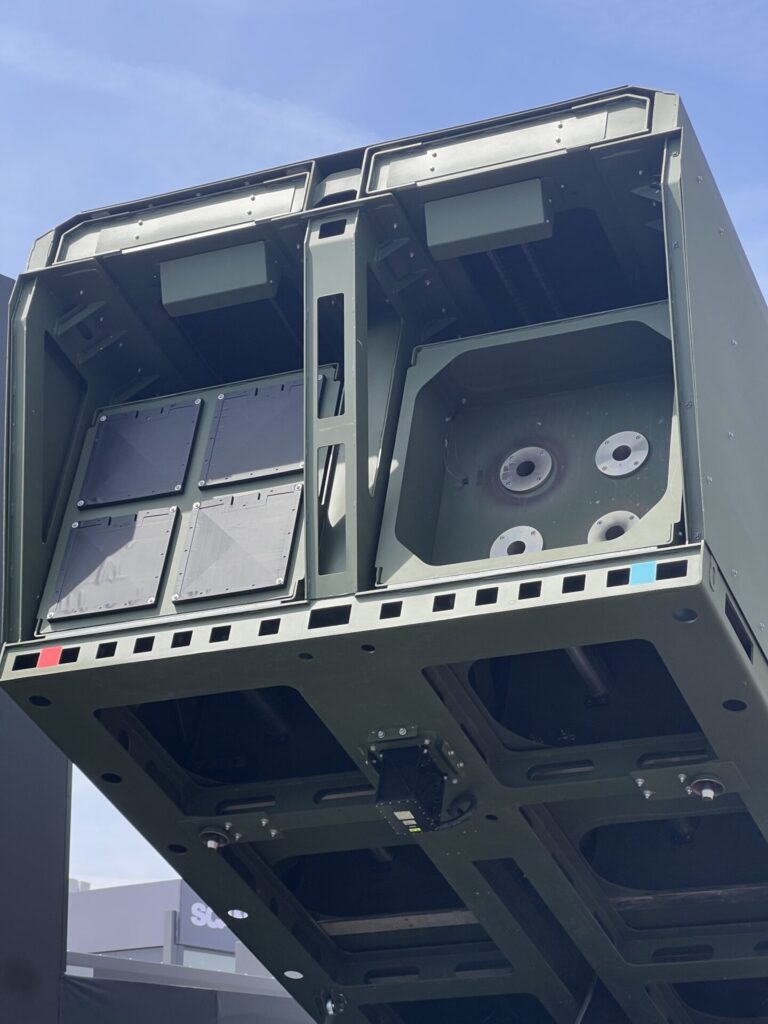
Soframe, a subsidiary of the industrial group Lohr, described X-Fire as a multirole launcher developed in a few months by teams from the three companies. The demonstrator has fired Thales exercise munitions at Camp de Suippes on May 20, 2026.
Soframe said the system could be brought into firing position in around one minute once the vehicle is in place, with a munition pod change taking about 10 minutes, allowing it to leave a firing area quickly after launch.
The launcher is designed to fire both French and foreign munitions across several range classes without changing the chassis, from rockets to ballistic munitions of around 150 kilometers and longer-range ballistic weapons up to about 1,000 kilometers.
Thales’ Hervé Dammann said compatibility with foreign weapons would be enabled by integrating the relevant fire-control computer and firing tables. Dammann said the consortium had aimed from the outset to build a polyvalent launcher rather than a system tied to that single contest.
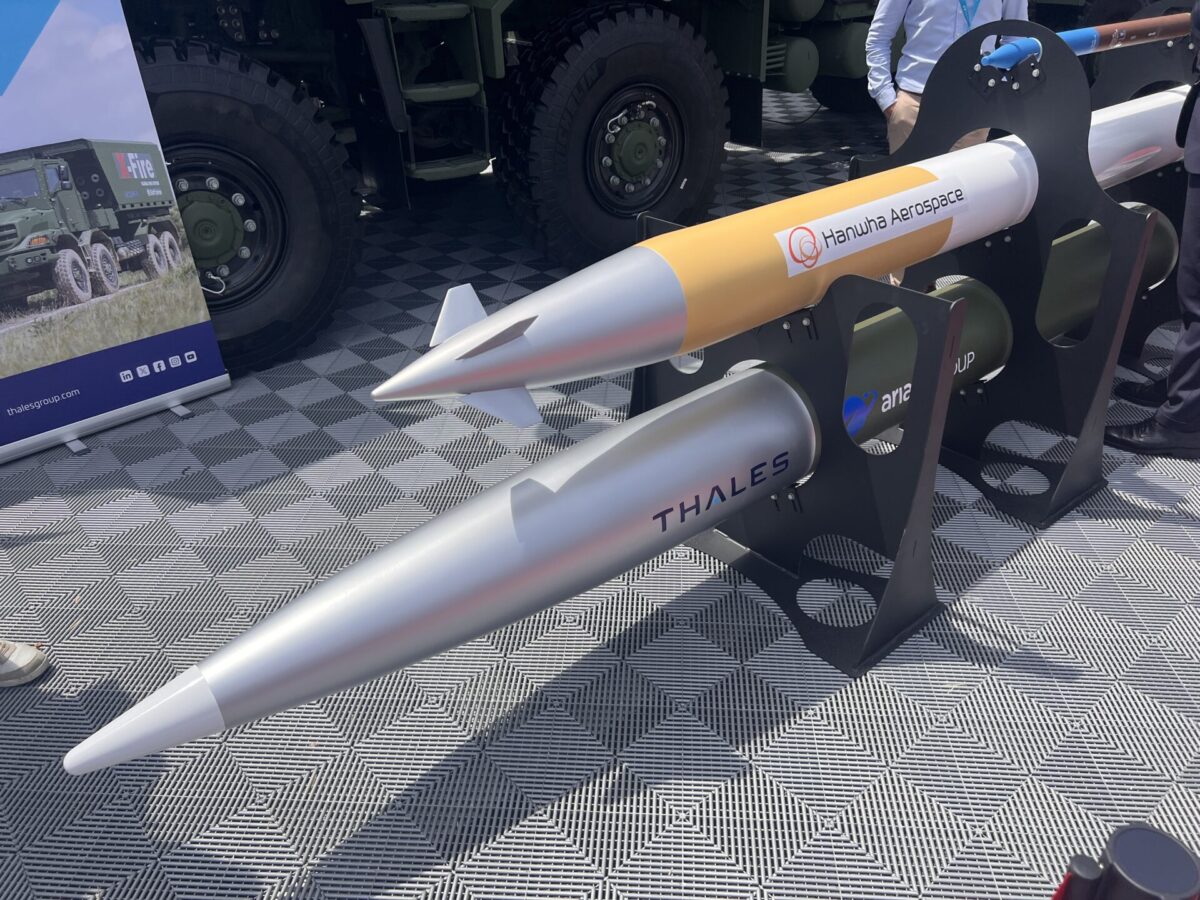
Displayed above Thales’ FTP-150 munition, which lost out to Thundart in France’s LRU replacement competition a day earlier, was Hanwha Aerospace’s CGR-080, an 80-kilometer Korean rocket used by the K239 Chunmoo system.
A conventional ballistic strike layer
🌍 At Eurosatory 2026, ArianeGroup, @thalesgroup and Soframe unveiled a sovereign ballistic strike line-up designed to address a broad range of operational requirements, from operational to pre-strategic missions.
— ArianeGroup (@ArianeGroup) June 17, 2026
At the heart of this new framework is the B-Strike family that… pic.twitter.com/52w7vRDPmS
For longer ranges, ArianeGroup is contributing what it calls the “trame balistique,” a conventional ballistic strike architecture. Vincent Pery, ArianeGroup’s director of defense programs, said the company and Thales had been working on a sovereign ballistic missile in the 1,000-to-2,000-kilometer class, drawing on the company’s expertise from France’s strategic deterrent and the M51 submarine-launched ballistic missile.
He emphasized that B-Strike is not a derivative of M51 or a conventional form of deterrence. Instead, it is a distinct capability that uses different materials and industrial processes, aiming to achieve higher production output and lower costs.
For the 2,500-kilometer-class B-Strike variant, the consortium would adopt a larger architecture, likely based on a semi-trailer or a heavier chassis. ArianeGroup said that configuration could carry several payload types, including a classic reentry vehicle, a maneuvering reentry vehicle, or a hypersonic glide vehicle, the latter shown in the consortium’s materials.
Pery pointed to the VMaX hypersonic demonstrator, which flew in June 2023, and to ArianeGroup’s SYLEX maneuvering reentry vehicle work, first launched on a sounding rocket on November 28, 2025, as evidence that the company already has relevant expertise in reentry and hypersonic payloads. He said the system is targeting sub-decametric precision, with the final requirement to be defined with the DGA.
Self-funded, awaiting DGA decisions
Pery said B-Strike had been self-funded so far and that ArianeGroup was ready to build a demonstrator and move toward flight testing, with the timing dependent on discussions with the DGA and French budgetary authorities. The consortium is seeking an initial contract to demonstrate technical and industrial maturity before a full development program.
ArianeGroup said it had received expressions of interest from several European countries for the 1,000-to-1,500-kilometer segment, though any export would require political authorization, with ballistic and hypersonic technologies subject to controls under the Missile Technology Control Regime (MTCR).
1 comment
Maybe the Ukrainian drone system used to avoid detection could be added to this system to make it even more effective. Especially if it is shared and implemented into the Ukrainian attack plan. Fire drones along with the missiles.