

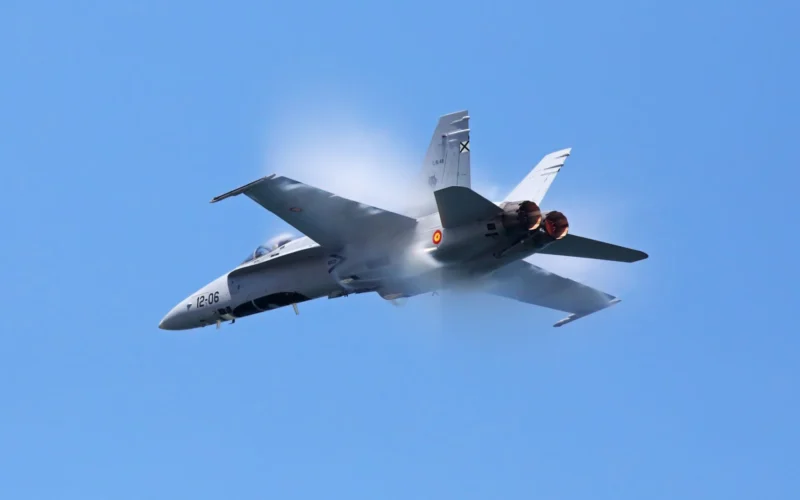
At the 2025 Festival Aéreo Internacional de Gijón, a sudden and unexpected maneuver by a Spanish Air Force EF‑18 Hornet caught the attention of thousands of spectators and quickly went viral on social media.
Evasive action over crowded beach
During a low-altitude display over San Lorenzo Bay on July 28, 2025, a Spanish F/A‑18 fighter jet executed a sharp evasive dive, trailing dark smoke and appearing to come unusually close to the water. The Spanish Air Force later confirmed that the pilot had performed the maneuver to avoid a flock of birds that suddenly entered the aircraft’s flight path.
Muchos nos habéis estado preguntando, por eso, en este hilo, os contamos qué pasó durante el festival aéreo de Gijón.
— Ejército del Aire y del Espacio (@EjercitoAire) July 28, 2025
Hilo 🧵 pic.twitter.com/oyY2ZNESEA
“This action is part of the usual protocol to preserve both the integrity of the pilot and the safety of the public,” the Ejército del Aire y del Espacio stated on social media platform X.
The pilot responded “with exemplary speed and professionalism,” the statement continued, avoiding a potential bird strike without compromising the overall demonstration. No injuries or damage were reported, and the aircraft safely returned to base.
The airshow drew more than 300,000 spectators, making it the largest in Gijón’s history. The lineup included displays by the Spanish Air and Space Force, Navy, Search and Rescue, the National Police, and aerobatic pilots flying light aircraft.
Bird strikes: real and recurring threat
The Gijón incident is not isolated. As recently as June 2025, a Spanish Eurofighter Typhoon collided with a seagull during a performance at the Aire25 airshow in Murcia. The bird shattered the aircraft’s canopy and punctured the windshield, forcing the pilot to abort the routine and land immediately. While the pilot was unharmed, the aircraft sustained severe damage, a reminder of how even a small bird can compromise high-speed military jets.
Here are some INCREDIBLE images of a high speed bird strike that penetrated the canopy. The pilot was able to safely recover the aircraft and only sustained minor injuries.
— Combat Learjet (@Combat_learjet) July 18, 2025
Thank you for sharing
IG: @ air_spotter7200 pic.twitter.com/e2w1UgsiPC
According to data from the International Civil Aviation Organization (ICAO), over 270,000 wildlife-related aircraft incidents were reported globally between 2016 and 2021, with more than 8,000 causing significant damage. Bird strikes are especially common during low-level flight near coastlines, wetlands, and migratory zones, conditions typical for summer airshows.
4 comments
B S! At that height and attitude, take a bird! You’ve got two powerful engines. That manouvre was a mistake that he was very lucky to recover from.
Very hard to believe ! To avoid a bird strike at very slow speed which probably casuses minimal possible damage, you don’t dive straight down to the water when at already a very low altitude. To me, that was a classic stalling of the right wing. Still well done to the pilot for the amazing recovery.
Looks like right aileron input in normal flight (no stall). What wonders me the pilot tried recovering the right roll with left aileron. When almost inverted the pith attitude was not corrected upwards, therefor during recovery the airplane ended up descending. High G recovery with pitch-up and, as it looks left rudder, saved his day.
When (in hindsight?) the pilot would have continued the right roll, keeping the nose high when inverted, the recovery would have been less risky.
Nice try guys!
Somebody has messed up big time here and they are scrambling to find an excuse… turns out the excuse is birds!
Luckily he managed to avoid crashing the aircraft but it was dam close!