
In recent times, the low-cost airline industry in the United States has been facing significant challenges.
The last few months alone have seen the demise of Spirit Airlines, a shareholder-driven business model turnaround at Southwest Airlines, plus the shrinking of Frontier Airlines’ fleet.
This contrasts sharply with the expansive approach taken by Allegiant Air. More used to keeping a low profile than making headlines, in 2026 the Las Vegas-based carrier completed the acquisition of Sun Country Airlines, a likeminded airline, with a highly complementary network, to create a major leisure-focused airline group.
Despite the divestment from its resort holdings having weighed down its latest financial results, Allegiant has emerged as one of the sector’s more resilient players. In 2025, the carrier posted a healthy operating profit, pressing ahead with a fleet renewal program which will soon see the B737 MAX become the airline’s workhorse.
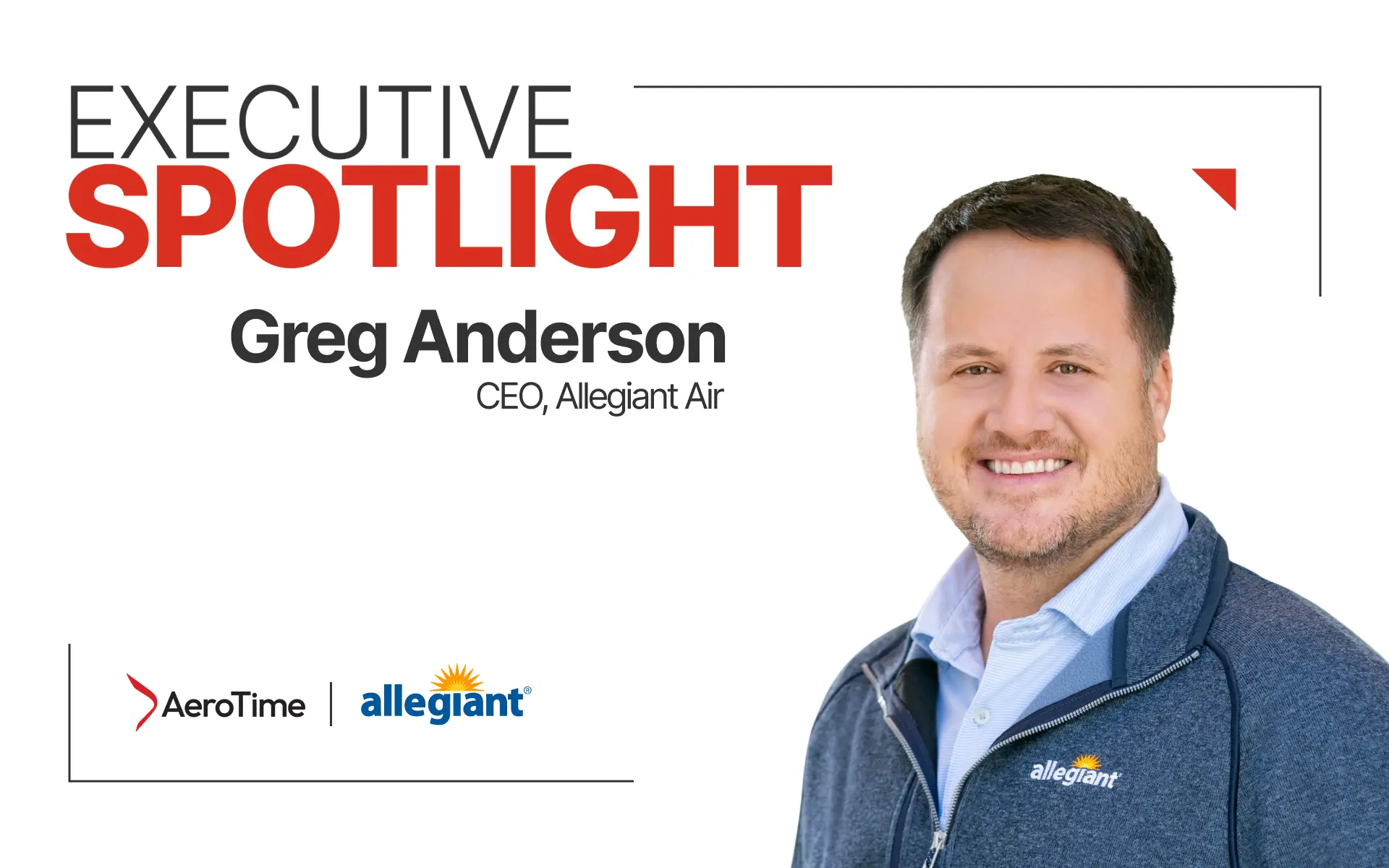
At the helm during this momentous period is Gregory Anderson, a company insider who joined Allegiant’s accounting department in 2010 before rising steadily through the ranks, serving successively as Principal Accounting Officer , Senior Vice President of Treasury , CFO and President, ultimately being appointed CEO in September 2024.
AeroTime had a long and thorough conversation with Anderson to learn more about this unique carrier, relatively little-known outside of its core markets, and find out the details of its no-nonsense approach to growth.
Setting the tone for the conversation, Anderson began: “Our airline business was profitable. We were at about 7% margin. We led the industry in the fourth quarter [of 2025] in the US and in the first quarter of this year [2026] with nearly a 15% margin.”
He also referred to the sale of Allegiant’s resort business in Florida, a deal in which the airline lost money, dragging down the company’s results for 2025.
“Over the past 18 to 24 months, we’ve really been focusing back on our core strength: the airline. We have a unique airline that serves the leisure customer in the US reliably. It’s been profitable, it’s difficult to replicate, and it’s been successful.”
Flexible utilization is key
Anderson enumerated the four pillars on which he claims Allegiant bases its success.
“Number one is our network, which is a real difference-maker,” he said. “We serve over 125 different communities and in the majority of them, around 75% or so, we’re the only nonstop option available.
“The second one is how we deploy capacity. We’re a low utilization carrier. On average, our aircraft work six to eight hours per day. We increase capacity during peak periods, which in the US are March, summer and holidays. And then, off-peak, we pull capacity back significantly.”
Anderson used a specific example to illustrate this point.
“We may have 550 flights on a Friday in July. And then on a Tuesday in September, we will have zero,” he explained. “We’re parking our fleet.”
“Number three is that we own our aircraft,” Anderson continued. “Over the years, we have been opportunistic about how we acquired aircraft. We like to consider ourselves as much as ‘aircrafters’ as airline managers. By this, I mean that we trade in the aircraft market and try to be opportunistic. That’s important to us, because it gives our model the flexibility it needs for that utilization approach that I mentioned.”
Anderson even put a number on the gains obtained from this approach.
“If we were to lease the same aircraft we own, it would be roughly double the cost over the life of that asset. So, it helps us maintain a low fixed cost structure, which is the fourth pillar that I like to highlight: we have a low fixed cost structure.”
Anderson also delved into the recent acquisition of Sun Country Airlines, the first ever deal of this sort in Allegiant Air’s history.
“Allegiant has a lot of similarities to Sun Country, and some differences as well,” he said. “I think we complement each other very well.”
When it was first announced in January 2026, this $1.5 billion deal was generally praised within the industry, as it brought together two airlines with a similar business model but somewhat complementary route networks. Sun Country is a carrier based in Minnesota which focuses on leisure routes, mostly connecting the northern Mid-West region to sea and sand destinations in the Caribbean. It also operates an air cargo operation, with Amazon Prime being one of its main customers.
“I think, together, we’re going to be even stronger and better able to serve the leisure market here in the US and beyond,” Anderson said.
In addition to adding scale to its operations and a degree of diversification, since the combined entity will keep Sun Country’s fleet of 22 cargo aircraft, the acquisition has also brought with it another positive side effect.
“40% of Sun Country’s revenue comes from fixed contracts, both for charter and cargo,” Anderson said. “So, 10 to 15% of proforma revenue for the combined company will be fuel-agnostic, because those will largely be fuel pass-throughs.”
He acknowledged that the increase in fuel prices is having an impact on the business’ bottom line, not least because there is a degree of discretion in leisure air travel.
“No one’s immune to that, no company is. Certainly, no airline is, and neither are we. It’s not a fuel access issue. It’s more of a fuel price issue. What we’re seeing is that it’s doubled. To put that into perspective, we consume roughly 60 million gallons per quarter. So, a $2 increase in the price of fuel is $120 million in incremental fuel costs for us”.
Anderson reiterated Allegiant’s laser-sharp focus on optimizing capacity. This is a constant feature of the model, but it becomes particularly important in times of high fuel prices.
“Where we see the most price sensitivity is during off-peak periods. That’s where we’re going to pull as much capacity as we can. The other area we’ve tried to help offset higher fuel costs is through shorter stage lengths. We’ll reduce stage lengths on certain markets, pulling back from them. What we try to do is concentrate as much capacity during those peak periods, because that’s when demand is still the strongest.”
In this regard, the fuel crisis has only intensified what Allegiant already does on a regular basis.
“On average, we get a utilization rate of six to eight hours,” Anderson explained. “Last year, we were at a little over seven hours per aircraft per day. In peak periods, we may be pushing our aircraft utilization over 10 hours per day. In those off-peak periods, fuel becomes a constraining factor. The higher the fuel price, the more you’ll cut capacity during those off-peak periods, because you don’t have the same demand environment where fares can offset the higher fuel.
“Now, we’re in a very volatile and dynamic fuel environment today, but that was just more of a broad approach to our business in a typical environment.”
“Those are the three kinds of key areas from a capacity perspective that helps us navigate the fuel environment, and particularly the fuel environment we’re seeing today. Capacity adjustments are the most effective way for us, with the price sensitive customers we serve, to offset the higher fuel prices,” he added.
On switching to the B737 MAX
In 2022, Allegiant, which had at that time been operating an all-Airbus fleet, placed an order for 50 Boeing 737 MAX aircraft, plus 50 options. The number of options was later increased to 80, when Boeing compensated the airline for delays with the delivery of its firm order.
Anderson praised the MAX for having helped keep fuel consumption low.
“The new MAX aircraft is roughly 20% more efficient than on our A320[ceo] series fleet, in terms of gallons per block hour. Last year, on a standalone basis, Allegiant had just over 10% of its ASMs [average seat miles, a measure of airline capacity – ed. note] produced by MAX aircraft. This year, it’ll be over 20%, and by 2028, over 50%. So that’s a structural advantage from a fuel efficiency perspective.”
Even before the fuel crisis, the efficiency of the MAXes was the key factor behind the decision to switch over to the type.
“The ownership costs of those MAX aircraft that we’re taking delivery of are very similar to our used A320s,” Anderson said. “We’re getting the same fuel benefit, at roughly the same ownership cost. We believe the combination with Sun Country will allow us to exercise more options than we otherwise would on a standalone basis.”
With the integration of Sun Country Airlines, Allegiant Air will not only operate legacy A320ceos and B737 MAXes, but also a fleet of 50 owned B737 NGs and 22 leased B737 freighters.
“Coming together, we think that the fleet strategy is very complementary,” Anderson said. “We have over $2 billion in embedded equity value between the two fleets. And again, we both own our aircraft, which is an important part of our model.”
Fleet diversity is something that Anderson did not appear to be too concerned about, as this is not new for Allegiant Air.
“In the past, we’ve operated three different fleet types. At one point, we had B757s, MD80s and A320s, so we’ve had experience operating multiple fleet types. We have under 22 bases now. And a base – it’s like an airline within an airline, because you’ll have aircraft that are dedicated to that specific base and your crews are domiciled there, your technicians who are familiar with that aircraft are there, and so on.”
“There are some mixed fleet bases, but what we’re doing, for the most part, is to isolate a specific base with either all Airbus or all Boeing aircraft. That helps mitigate the complexity of a multiple fleet type in a particular base. I think it’s a unique feature of the Allegiant model that helps us mitigate some of the complexity with the dual fleet type,” Anderson added, while reiterating his satisfaction with the performance of the B737 MAXes.
“All of that came into the decision making, but ultimately it is the fact that we thought that the ROI [Return on Investment – ed. note] on the aircraft made a ton of sense,” he continued. “As we’ve taken delivery of those MAX aircraft, the reliability, the fuel efficiencies, and savings that we’re getting from the MAXes – their ‘earnings power’, that would probably be the right term – it’s been terrific. So, we’re really pleased with it as part of our fleet.”
If there’s one thing Anderson doesn’t shy away from, it’s Allegiant’s reputation in the industry for obtaining strong deals for its aircraft.
“We acquired 13 end-of-line A320ceo from Airbus back in 2016 or 2017, so we had experience of buying new aircraft. When we got to the point where we had more than 100 aircraft, though, we felt that, in order to continue scaling, it made sense to have a foundation of new aircraft coming in, but it had to be at the right price. We weren’t going to chase anything. So, just coming out of the pandemic, it was a unique point in time when we took a look at what the market was like for new aircraft. I think it was a well-timed order.”
Ancillaries and diversification
If the airline business was working well, though, why invest in on-the-ground resorts?
“The initial thesis for that investment was that we also sell revenues outside of the ‘tube’, outside of the plane. We call them third party revenues, and they’ve been a very important part of our business. It’s high margin as well: car rentals and hotel rooms. In Las Vegas, for example, where we started with this model, we would sell a lot of third-party hotel rooms. We have direct distribution through our site, and we have that connection with our customers.”
Anderson explained how, at the time, investing in its own resort it was seen as one more step in this direct relationship with its customers.
“We were bringing millions of customers to Southwest Florida, most of them on vacation. As you sell the airfare, you can package it with the hotel. This was a first party product.”
But things soon started to go wrong, with external shocks playing a major role.
“As we went through that process, we had multiple hurricanes and a pandemic in the middle of it that really increased the cost of it all,” Anderson explained. “There were other factors, but when I took the CEO seat back in late 2024, we wanted to get back the focus on our core strength: the airline. So, we made the decision to sell. That also was part of a readiness plan for us to be able to move forward with our first acquisition, which is Sun Country Airlines.”
When asked why so many budget airlines have been struggling in some way or another in the US recently, Anderson replied:
“Some of that, I believe, is that legacy carriers, with their product segmentation, were able to price seats in the back of the cabin that competed with the ultra-low-cost carriers that also had high utilization, which is not the case with Allegiant. So, they were able to siphon a significant amount of customers from the low-cost carriers. This obviously hurt some of those higher utilization carriers that, pre-pandemic, were going head-to-head with the big guys.”
At this point, Anderson again emphasized Allegiant’s main points of differentiation.
“Allegiant and Sun Country are very different. We were two of the leaders in profitability last year when it comes to the airline business if you remove the hotel deal. We have strong, healthy balance sheets. We own our aircraft. That’s how we designed our model,” he said. “These were decisions we made years ago to protect margins. It wasn’t to chase growth. We’ve been focused on being different. We’ve served the leisure passenger successfully for 20 years, and we think those ingredients will continue to allow us to serve it successfully for many years ahead.”
Trends in leisure travel
Does Anderson see any generational changes in the way people book their holidays?
“There are trends that show that the younger generation puts a lot of value on the experiential nature of things,” he said. “For example, we don’t have Wi-Fi today, but it’s something that, as we have said publicly, we expect to have down the road. Because that younger generation, there’s a portion of them that expect Wi-Fi on the aircraft and it’s becoming table stakes.”
Anderson was very clear about the underlying philosophy which underpins Allegiant’s model, although he appeared ready to adapt the product to the changing needs of the market.
“It’s important that we stay core to who we are, which is about affordability, convenience, and reliability. However, on 70% of our aircraft, we have rolled out what we call our ‘Allegiant Extra’ product, which is our version of a premium product, with extra legroom seats. We’ve really been focused on adding this over the past few years, to get to the point where we’re at today, when all new MAX aircraft being delivered have it.”
Market feedback on this new offering has proved to be positive, Anderson revealed.
“We first rolled it out in a handful of markets we figured would be successful because of the stage length and profile,” he said. “As we continued to scale our Allegiant Extra program, we saw that it was resilient and demand for it didn’t subside – it remained strong. It’s been wildly successful.”
While keeping the basics of its model in place, Allegiant will continue to invest in tweaking its value proposition.
“We’re running through a lot of technology transformation here at Allegiant. As part of that, we built the whole airline on proprietary software that, over the past few years, we’ve switched to more state-of-the-art systems. They allow us to be more nimble and quicker in different areas, to get better data and make better decisions. Also, it’s about how we communicate and talk to our customers, really stepping up our game.”
“Our strategic focus on the commercial side is centered around that relationship with the customer,” he said. “I’m really excited about a lot of the work that’s taken place, but we still have more work to do in addition to what I’ve mentioned – with Allegiant Extra, with Wi-Fi, looking at different ways our loyalty programs can continue to improve and strengthen so that our customers keep finding value in them.”
So, where does Anderson see Allegiant five years from now?
“I see us being the leading leisure carrier in the United States. I think combining with Sun Country is really going to help us to accelerate that strategy. It’s the right partner at the right time, for the right reasons,” he said. “I am excited about it. We have a lot of work ahead of us!”