

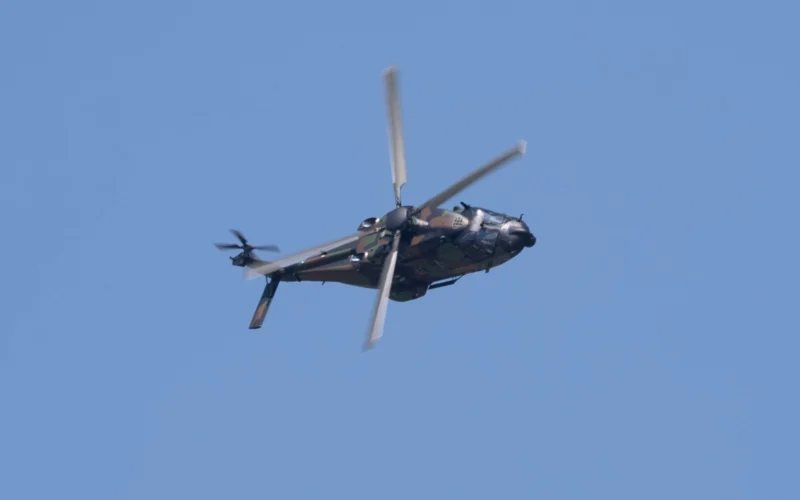
The French Army’s helicopter arm (ALAT) argues that the war in Ukraine is pushing armed forces to adjust tactics rather than abandon crewed rotorcraft in high-intensity conflict, even as drones and unmanned systems expand into roles once reserved for attack and reconnaissance helicopters.
In comments to French weekly Le Point, General David Cruzille, who commands the French Army’s helicopter branch, and his deputy General Hubert Doutaud said early predictions in 2022 that helicopters were becoming untenable in modern war have not been confirmed by events.
Tactics mattered more than the platform in early Ukraine fighting
Rotary-wing aviation has repeatedly absorbed high attrition in past wars. Vietnam alone saw more than 5,600 US helicopters lost, most to accidents and collisions. Yet operators responded by changing tactics rather than retiring helicopters from service.
In the same way that battle tanks or aircraft carriers are periodically declared obsolete, the prediction that helicopters were “over” circulated widely after February and March 2022 as Russian Ka-52 and Mi-8 aircraft took heavy losses during the failed assault on Hostomel airport near Kyiv.
According to Cruzille, Russia’s helicopter losses in early 2022 reflected how they were employed. Aircraft flew higher and during daylight, exposing them to short-range air defense systems (including MANPADS) and fighters.
Once Russian crews shifted to lower-level operations at night, attrition declined, and helicopters played a greater role during Ukraine’s unsuccessful 2023 counteroffensive, serving as fast anti-armor responders along the front.
Ukraine, meanwhile, repurposed its surviving Mi-8 transports and attack helicopters as mobile counter-drone shooters, flying in pairs at night to target slow Shahed-type loitering munitions at low altitude.
Cruzille also pointed to the recent US raid in Venezuela, which relied on attack and transport helicopters to insert commandos, as an illustration of why he believes crews will remain central in many high-end missions.
Helicopters retained relevance where they could operate at low level, integrate tightly with ground maneuver, and offer precision mobility over terrain that vehicles could not cross at scale.
What can be dronized and what remains crewed
Where helicopters have come under the most pressure is in deep reconnaissance and stand-in strike missions that require penetrating dense air defenses. Several NATO armies are shifting those roles toward drones, loitering munitions, and air-launched effects, arguing that expendable unmanned systems can absorb risk that crewed aircraft cannot.
The United States has moved furthest in this direction. In 2025, the US Army confirmed plans to cut several legacy manned helicopter units and expand drone swarms, attritable sensors, and launched effects as part of a broader aviation overhaul. The cancellation of the FARA armed scout helicopter reinforced the trend: reconnaissance deep inside contested airspace is now seen primarily as an unmanned mission.
By contrast, medium-lift roles that combine troop transport, medevac, fire support, and command-and-control are expected to remain crewed for the foreseeable future. These missions demand judgment, communication with ground forces, and real-time interpretation of adversary behavior, qualities that France’s helicopter commanders argue remain difficult to automate.
“To deploy twenty commandos into a combat zone, we will always use helicopters with a crew on board,” Doutaud explained. “[…] In Libya, during the initial raids, we made Gaddafi’s soldiers understand we were only after the equipment. When they heard us coming, they regrouped away from the vehicles, knowing we wouldn’t fire on them. I’m not sure drones could have done that.”
Cruzille is skeptical that large vertical takeoff drones will offer a simple or cheaper substitute for helicopters, arguing that once they require turbine-class power and useful endurance, they converge toward helicopter-like size, complexity, and cost.
Recent US programs partially cut across that view, where heavy-cargo resupply is seen as an early use case for large rotary drones, since it removes crews from predictable flight patterns near the front.
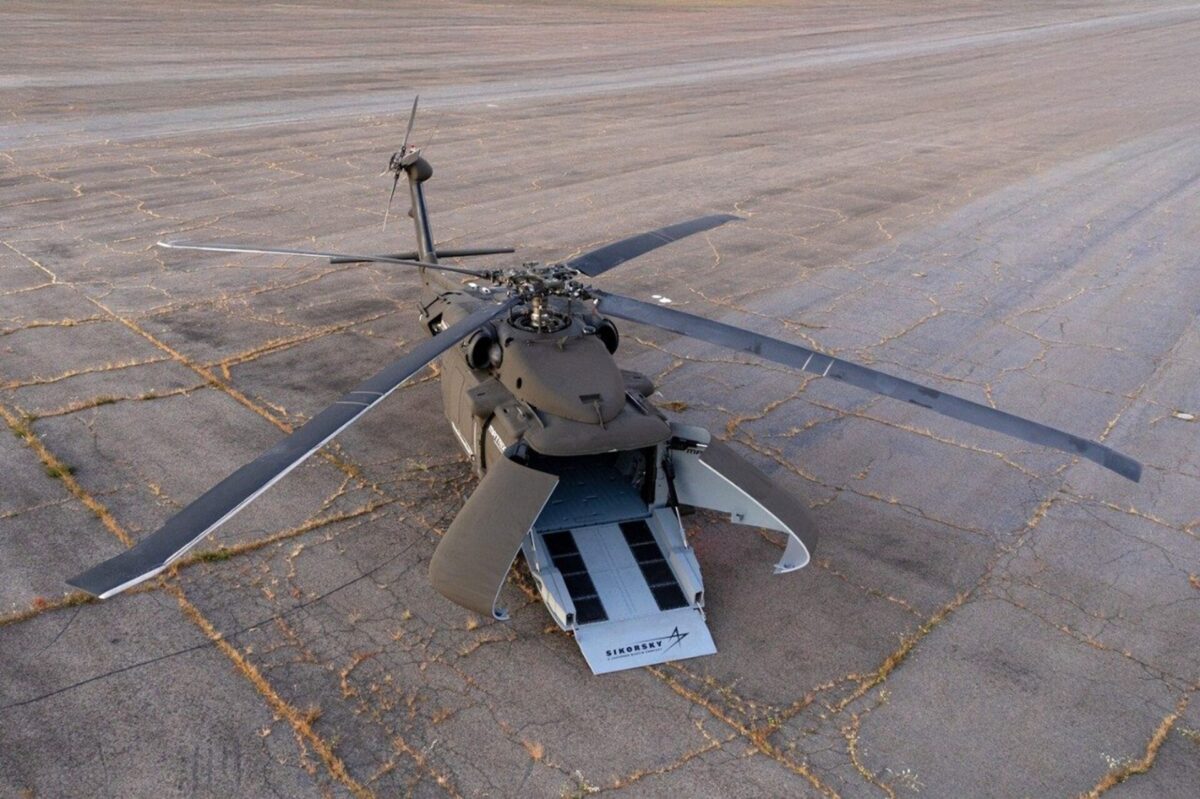
For example, Sikorsky’s U-Hawk concept removes the cockpit and crew from a UH-60 Black Hawk and turns it into a fully uncrewed cargo aircraft for autonomous resupply. The model does not escape helicopter economics, since the underlying airframe remains a Black Hawk, but it does aim to replace some crewed lift missions with a large drone, freeing up crewed helicopters for other missions.
Counter-UAS and ‘drone-carrying’ helicopters
Both officers pointed to counter-drone warfare as one of the most consequential new mission sets for rotary aviation. France has begun integrating anti-UAS tasks into the employment of its Tiger attack helicopters, whose cannon and sighting systems are suited to tracking small aerial targets at night. Transport helicopters such as the NH90 Caïman could also contribute with cabin or rear-ramp gunners.
Other Western militaries are exploring similar concepts. The US Army has used Apache attack helicopters to engage small drones during demonstrations, leveraging cannon and guided 70mm rockets as part of a layered counter-UAS approach.
French planners are also exploring manned-unmanned teaming concepts in which Tigers or Caïmans would release small drones from the aircraft to provide reconnaissance several kilometers ahead of the formation.
US manufacturers are moving in a similar direction, with Sikorsky promoting digital backbones that allow Black Hawk and CH-53K crews to task and recover multiple unmanned assets in flight.
The approach preserves the agility and judgment of crewed aviation while pushing risk and sensing forward onto expendable platforms, echoing the fixed-wing “loyal wingman” concepts now being developed alongside the next generation of fighter jets.
Modernization and fleet renewal
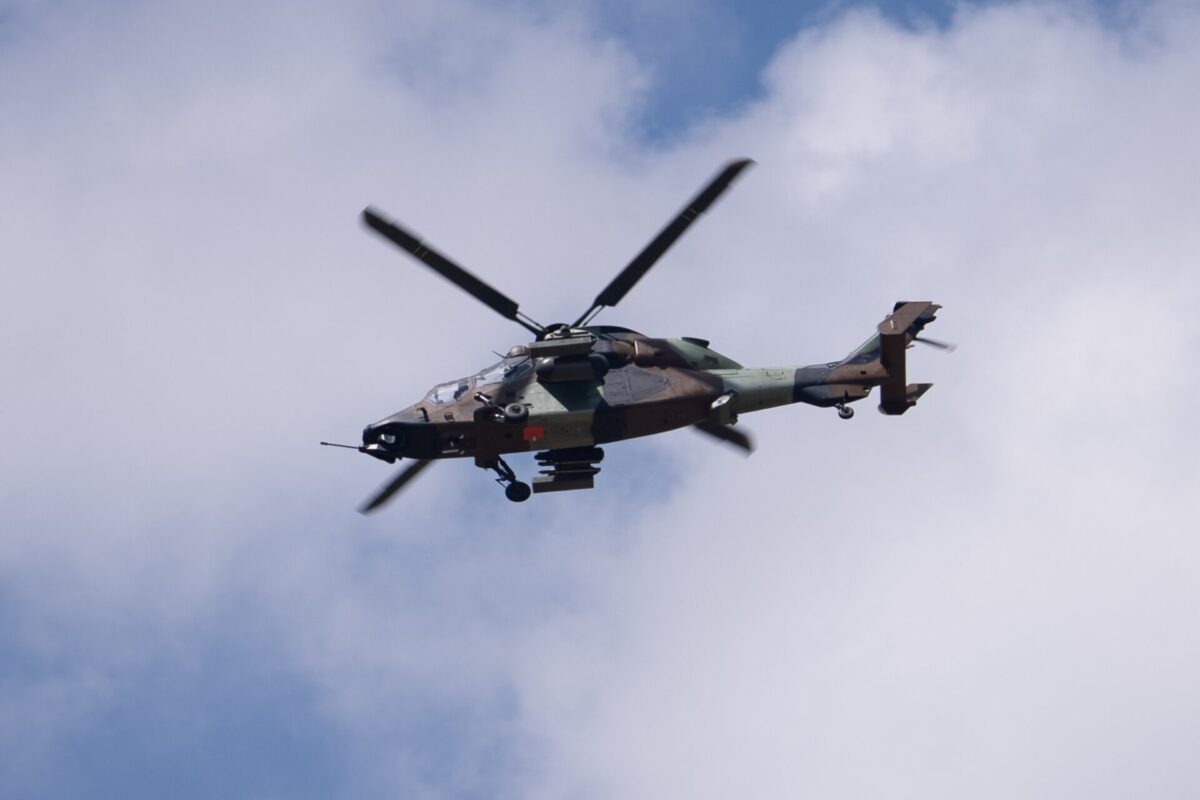
France is backing these tactical shifts with modernization spending. A mid-life upgrade for the Tiger, confirmed in 2025, is intended to keep the platform credible into the 2040s.
In parallel, France and Spain have launched new development contracts to enhance the NH90 Caïman special forces variant’s performance in low-visibility environments, including new helmet-mounted sight and distributed vision systems.
With France’s helicopter fleet still spanning roughly a dozen types, the new HIL Guépard light helicopter, derived from Airbus’s H160 civilian platform, will be fielded from 2029 onward to replace five older fleets across the three services. Planned at 169 units to replace five older fleets, the Guépard is expected to become a core light and medium-lift asset.
Taken together, these investments indicate that France expects crewed helicopters to remain central to its land forces through the 2030s, even as drones absorb a larger share of high-risk or persistent roles.