

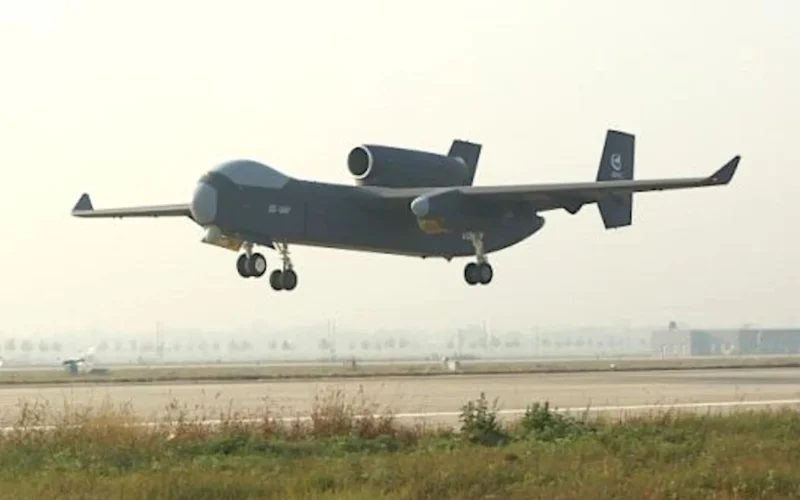
China has conducted the first flight of a large jet-powered unmanned aircraft designed to carry and deploy dozens of smaller drones, marking a significant step in the country’s push toward long-range, networked uncrewed aircraft capability—often referred to as drone swarms.
The “mothership” aircraft, known as Jiutian, or “Nine Heavens,” took off for the first time in December 2025 from the Pucheng region of Shaanxi Province, according to Chinese state-linked reporting and defense media coverage. The flight followed the drone’s public debut at the Zhuhai Airshow in 2024, where it was presented as a high-payload, multi-role unmanned platform.
Media reporting describes Jiutian as having a wingspan of about 82 feet and a maximum payload capacity of roughly 13,200 pounds. The jet-powered drone is designed to carry a mix of internal and external payloads, including missiles, bombs, electronic warfare equipment, and large numbers of smaller unmanned aerial vehicles. Concept imagery released by the Chinese military shows the aircraft equipped with what appears to be a nose-mounted surveillance or sensor pod.
Chinese media outlets have focused particular attention on the aircraft’s ability to deploy large numbers of smaller drones in flight. Some reports suggest the platform could carry and release up to 100 smaller UAVs, enabling coordinated operations once airborne. While operational details remain limited, such a capability would place Jiutian within a growing category of unmanned mothership aircraft.
The drone is reportedly controlled remotely via satellite, allowing it to operate at long range. Estimates cited in defense reporting suggest a potential range of several thousand miles and endurance measured in many hours, positioning the platform for extended missions far from its launch point.
Chinese officials have emphasized the aircraft’s modular design and dual-use potential, saying it could also be configured for cargo transport, reconnaissance, communications relay, or disaster relief missions. The ability to disperse large numbers of smaller drones aligns closely with broader ideas in Chinese military doctrine emphasizing distributed sensing, electronic warfare, and saturation tactics.
The concept of deploying multiple smaller drones from a single airborne platform has drawn interest globally as militaries explore ways to complicate air defenses and extend reach without risking crewed aircraft. In such operations, the smaller drones may operate cooperatively, sharing data or dividing tasks. Jiutian itself would serve as the launch and coordination platform as key component of the swarm, enabling the smaller systems to operate closer to targets.
China has increasingly highlighted advances in unmanned and autonomous systems as part of its military modernization efforts, including loyal wingman aircraft, long-endurance surveillance drones, and experimental stealth UAV concepts. The first flight of Jiutian suggests those efforts are now extending into heavier, more complex uncrewed platforms designed to act as force multipliers.