

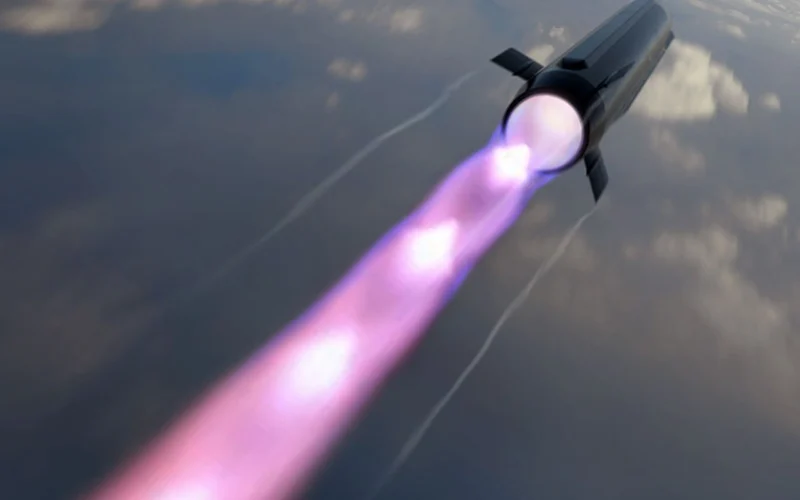
GE Aerospace and Lockheed Martin have completed a series of ground tests of a liquid-fueled rotating detonation ramjet (RDRJ) intended for next-generation hypersonic missile applications.
The campaign, conducted at GE Aerospace’s Research Center in Niskayuna, New York, represents the first project completed under a wider technology development agreement between the two companies.
The tests validated ignition and steady-state operation of the RDRJ under conditions representative of high-speed missile flight. Engineers used direct-connect testing methods, injecting high-velocity air into the inlet and combustor to simulate a range of operating points from supersonic to hypersonic regimes.
According to the companies, the results exceeded expectations and confirmed that a liquid-fueled RDRJ can function at missile scale with stable detonative combustion.
Detonation combustion for range and compactness
The RDRJ concept differs from traditional ramjets by using continuous detonation waves to burn fuel and air.
Detonation combustion is expected to deliver higher thermodynamic efficiency, higher specific thrust, and a more compact propulsion unit than conventional deflagration-based ramjets.
In practical terms, GE and Lockheed Martin argued that a missile powered by an RDRJ could sustain hypersonic speeds over longer ranges while carrying more fuel or payload in the same form factor.
Another point highlighted is the lower takeover speed. Because the RDRJ can ignite at lower Mach numbers than classical ramjets, future missiles may require smaller rocket boosters to reach operating speed. Reducing booster mass would free additional internal volume and potentially lower system cost and logistical complexity.
For missile designers, the combination of higher efficiency, compactness, and lower takeover speed could translate into more flexible airframe and launcher options. A smaller booster and shorter overall propulsion section leaves more room in the missile for guidance, warhead options, or additional fuel, while keeping within existing launcher envelopes. That mix is particularly attractive for air-launched or shipboard systems where space and weight margins are constrained.
Part of a wider hypersonic propulsion push
The latest demonstration follows earlier GE Aerospace hypersonic propulsion work. In late 2023, the company reported a dual-mode ramjet rig test that used rotating detonation combustion in a supersonic flow, and in 2025, it completed a supersonic flight test of a solid-fuel ramjet system on a Starfighters Aerospace F-104 over Florida.
Lockheed Martin has been pursuing detonation rocket and air-breathing technologies through investments in startups, including Venus Aerospace in 2025, which has developed a flight-proven, high-thrust rotating detonation rocket engine (RDRE).
GE Aerospace and Lockheed Martin expect to continue maturing the RDRJ through 2026, focusing on expanding the operating envelope, refining the inlet–combustor interface, and preparing for potential future flight demonstrations.