

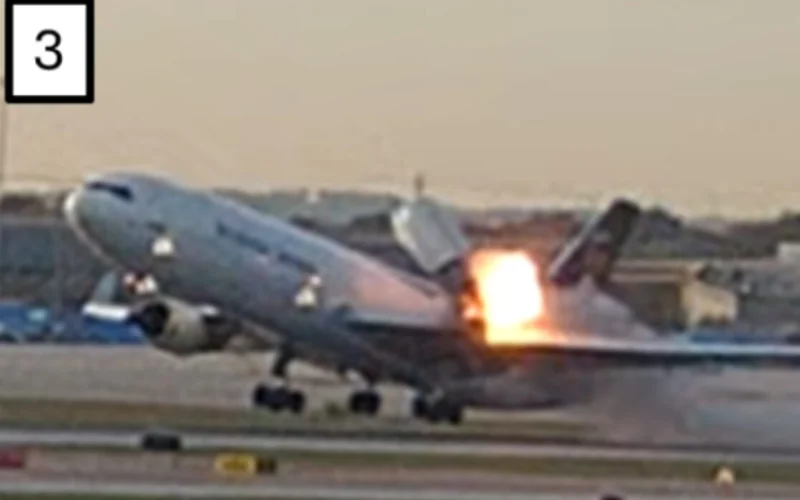
The National Transportation Safety Board has released a new investigative update into the crash of UPS Airlines Flight 2976, providing additional detail on the structural failure that occurred shortly after takeoff.
The cargo flight crashed near Louisville, Kentucky, on November 4, 2025, after departing Louisville Muhammad Ali International Airport (SDF). The aircraft, a McDonnell Douglas MD-11F, was destroyed and both pilots were killed.
In its latest update, the NTSB said examination of the wreckage confirmed that the aircraft’s left engine and its pylon separated from the wing moments after takeoff. Investigators determined that the separation occurred at the engine-to-wing attachment point, a critical structural area designed to support engine loads during all phases of flight.
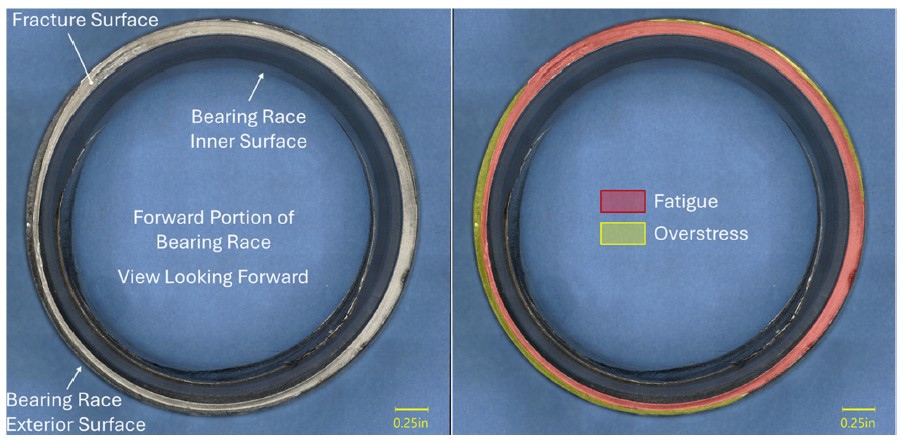
According to the NTSB, detailed analysis conducted at the agency’s materials laboratory identified fatigue cracking in components associated with the left engine pylon attachment. Investigators found cracking that had developed over time, along with evidence of additional damage consistent with the structure failing under load once the final separation occurred.
Airport surveillance video reviewed by investigators shows the left engine and pylon detaching from the wing shortly after the aircraft lifted off. The video also captured a fire in the area of the left engine immediately following the separation, before the aircraft descended and impacted terrain.
The NTSB said both the cockpit voice recorder and flight data recorder were recovered from the wreckage and are being used to reconstruct the final moments of the flight. Data from the recorders has helped investigators align recorded aircraft performance with physical evidence found at the accident site.
The update does not assign probable cause and does not identify responsibility for the failure. The NTSB emphasized that the investigation remains ongoing and will continue to examine maintenance history, inspection records, and certification standards related to the engine pylon structure.
The agency has not yet issued safety recommendations related to the findings, but the new information provides the clearest picture so far of the mechanical sequence that led to the loss of the aircraft.
UPS has said it is cooperating fully with the investigation.
Following the November 2025 crash, the Federal Aviation Administration (FAA) issued an Emergency Airworthiness Directive that effectively grounded the global fleet of McDonnell Douglas MD-11 aircraft pending inspections.
Major operators, including UPS Airlines and FedEx Express, had already voluntarily removed their MD-11 freighters from service before the FAA action. The directive was later expanded to include related DC-10 and MD-10 variants because of shared engine pylon design features. Aircraft were permitted to return to service only after completing FAA-mandated inspections and corrective actions developed with support from Boeing.
The grounding disrupted cargo operations during the peak shipping season but reflected regulators’ concern that the failure seen in the UPS crash could pose a broader risk across the fleet.
The MD-11F has been a mainstay of UPS’s long-haul cargo fleet for decades, and the crash has drawn close attention across the cargo aviation sector, particularly regarding aging aircraft structures and inspection practices.
The NTSB said further updates will be released as additional analysis is completed.
8 comments
I wish they order examination of such critical parts of engine to wing attachment on ALL the planes of similar age to replace fatigued and cracked parts.
Also, I wish they had examined the engine 3 [ right wing engine ] and add to their report how bad the other side of plane was. How long could that go before that came off too. I know it may not be relevant, but for the assessment of air worthiness as well as the maintenance standards of such companies must be probed as deep as possible.
We cannot have another such incidence to happen, can we ?
You seem to omit what the NY Times has said of Boeing new of this and done nothing,
Boeing Knew About Flaws in UPS Plane That Crashed in Louisville, N.T.S.B. Says
In a report Wednesday, the National Transportation Safety Board said fractures that appeared to have led the left engine to separate from the plane’s wing had occurred at least four other times.
Sadly, we see human error everywhere here. Our real problem is never learning from past mistakes.
Tell that to the thousands of pilots, about whose incidents you never heard, because they did learn from others’ errors, and apply that knowledge, or the ones faced with an incident for which there was no prior training,but who took yrs of experiences and extrapolated a safe landing, or at least controlled crash that saved lives. Yes, humans do make mistakes, but so do computers.
A Known Issue: The 2011 Warning
The NTSB’s findings point to a significant historical precedent. On February 7, 2011, Boeing issued Service Letter MD-11-SL-54-104-A following four similar bearing race failures across three different MD-11 aircraft.
Despite the documentation of this flaw, the risks were downplayed at the time:
Boeing’s Assessment: The company deemed the issue “not a safety-of-flight” concern.
Seems to me that any part of a 30+ year old airplane that is subject to stresses should receive frequent and extensive inspections. Moreover, when the potential defect is pointed out by Boeing, the operator and maintenance organization should pay special attention to these areas even if no recommendation to immediately replace is directed. Another indication of how operators may try and save money by minimizing maintenance costs. JMO
The FAA also ordered air worthiness inspections of the DC-10 & MD-11 prior to this incident as I recall!
The aircraft has just come out of maintenance from ST Engineering, a Singapore Government owned MRO facility.
Why was this crack not detected during the initial airframe inspection by the maintenance facility?