

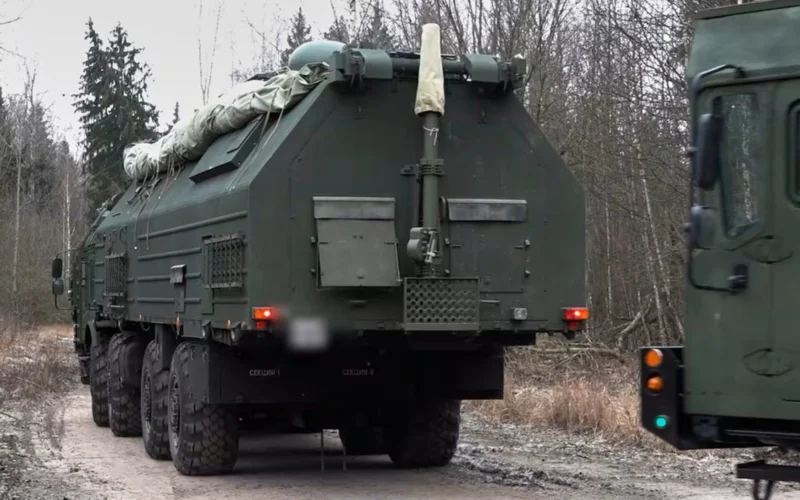
Russia fired an RS-26 Rubizh “Oreshnik” intermediate-range ballistic missile at the Bila Tserkva area in Kyiv Oblast during a large overnight combined strike on Ukraine, the Ukrainian Air Force confirmed on May 24, 2026. The launch was carried out from the Kapustin Yar range in Russia’s Astrakhan Oblast. It marks the third confirmed combat use of the system.
The Ukrainian Air Force said it tracked 690 weapons between 18:00 on May 23 and the morning of May 24, with Kyiv designated as the main direction of attack.
Alongside the Oreshnik, the package included two Kh-47M2 Kinzhal aeroballistic missiles, three 3M22 Zircon anti-ship missiles, 30 Iskander-M and S-400 ballistic missiles, 54 Kh-101, Iskander-K and Kalibr cruise missiles, and 600 attack drones combining Shahed, Gerbera and Italmas types with “Banderol” loitering munitions and “Parodiya” decoys.
The aftermath of the Oreshnik intermediate-range ballistic missile strike on Bila Tserkva, according to Ukraine’s State Emergency Service (DSNS):
— Special Kherson Cat 🐈🇺🇦 (@bayraktar_1love) May 24, 2026
“A fire broke out at a garage cooperative in the city of Bila Tserkva. Three garages were on fire.” https://t.co/mW1BzQmFfo pic.twitter.com/D4K3rmQ1OZ
The Ukrainian military said its air defenses shot down or suppressed 604 targets, including 55 missiles and 549 drones. Eleven Iskander-M and S-400 ballistic missiles were intercepted, alongside 44 cruise missiles. A further 19 missiles were assessed as having failed to reach their targets. Sixteen missiles and 51 drones impacted 54 locations across the country.
Kyiv mayor Vitali Klitschko reported at least one fatality and more than 20 injured in the capital, with damage across the Shevchenkivsky, Dniprovsky and Podilsky districts. Poland scrambled its own and allied fighter jets to protect Polish airspace during the attack.
In an X post later in the morning, Ukrainian President Volodymyr Zelenskyy said at least 83 people had been injured since midnight and renewed his appeal to partners.
“It is critically important to continue working to secure air defense for Ukraine, especially anti-ballistic capabilities,” Zelenskyy said.
Combined strike warning
The strike followed a warning by Zelenskyy on May 23, 2026, that intelligence shared by Washington and European partners pointed to a possible Oreshnik launch. The US Embassy in Kyiv issued a parallel security alert.
The Russian framing came from an order by President Vladimir Putin to his defense ministry to prepare retaliation options for a Ukrainian drone strike on a college dormitory in Starobilsk, in occupied Luhansk Oblast. Russia said at least 12 people had been killed there.
Ukraine’s General Staff denied targeting the dormitory and said its drones had struck a headquarters of “Rubicon,” an elite Russian unmanned systems unit operating in the area.
Oreshnik track record
The RS-26 Rubizh “Oreshnik” is a nuclear-capable intermediate-range ballistic missile that Moscow first fired against Ukraine on November 21, 2024, striking Dnipro with what Ukrainian sources said were dummy warheads. Russia used the system a second time on January 9, 2026, against infrastructure in Lviv Oblast.
Putin has claimed the missile travels at Mach 10 and cannot be intercepted; Ukrainian analysis of debris from the Dnipro strike concluded that the design rests on dated Soviet-era technology consistent with the discontinued RS-26 program.
After the January strike, the leaders of France, Germany and the United Kingdom condemned its use as escalatory and unacceptable. Ukraine’s Patriot and SAMP/T batteries have engaged the Kh-47M2 Kinzhal and 3M22 Zircon, but neither system has been credited with intercepting an Oreshnik.